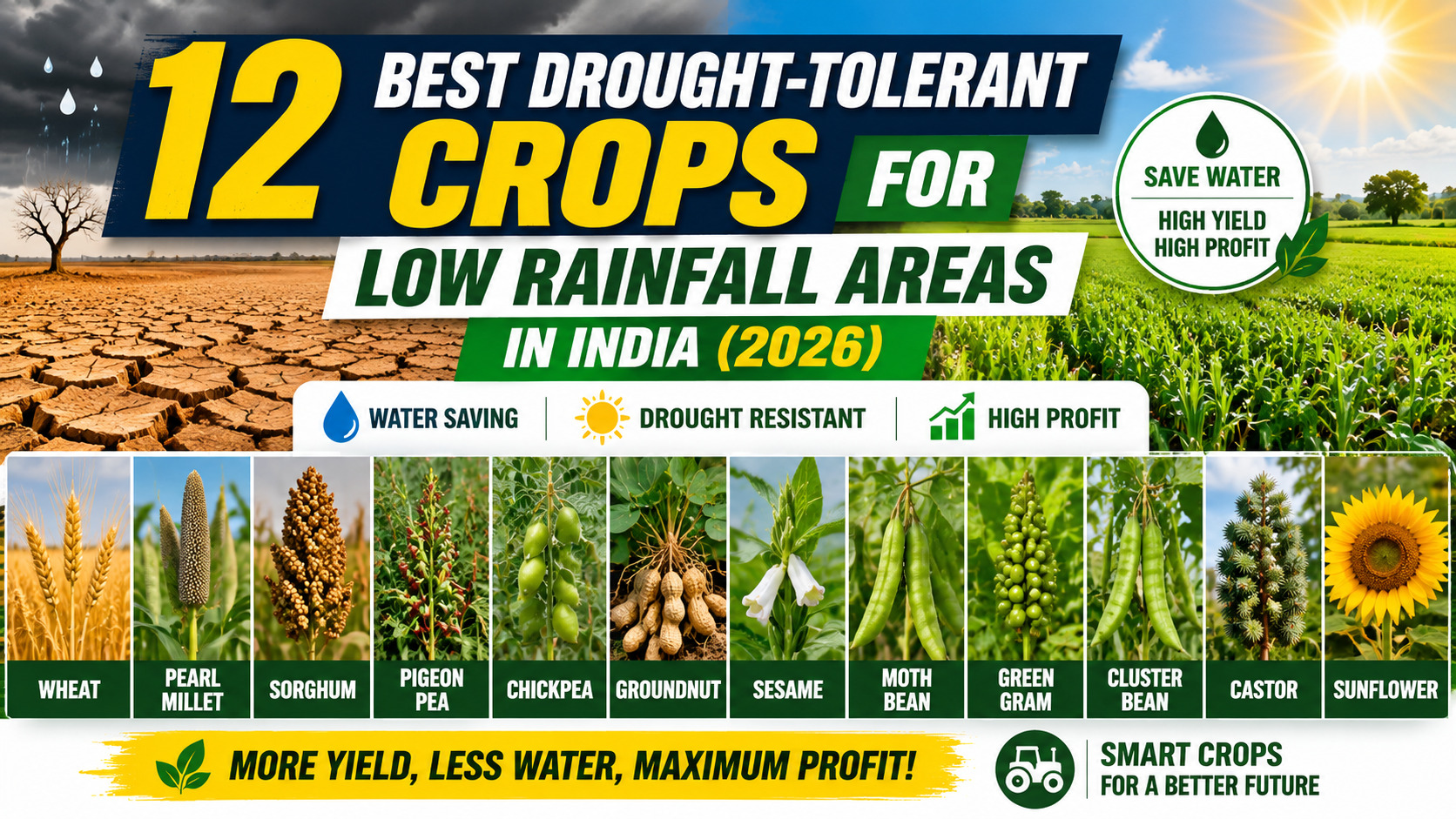
Best Crops for Low Rainfall Areas in India: 12 Drought-Tolerant Choices for 2026
25/06/2026, Published on Aafrin Narmawala

Best Crops for Low Rainfall Areas in India: 12 Drought-Tolerant Choices for 2026

The best crops for low rainfall areas in India are millets (bajra, jowar, and ragi), pulses (moong, chickpea, and pigeon pea), and oilseeds (mustard, sesame, and groundnut). These crops survive on 400–750 mm of annual rainfall and tolerate extended dry spells better than water-intensive crops like rice or sugarcane.

Farmers across Rajasthan, Maharashtra, Gujarat, Madhya Pradesh, and parts of Karnataka rely on these crops because their fields receive monsoon rain only, with little or no assured irrigation. This guide explains which crops work best, why they work, and how to manage them for a reliable harvest even in a dry year.

What Makes a Crop Suitable for Low Rainfall Areas

A crop is suitable for low rainfall farming if it needs less water overall, has a short growing cycle, and can survive temporary moisture stress without major yield loss. These three traits matter more than any single feature.

Key characteristics to look for:

  • Short duration: Matures in 70–100 days, reducing total water exposure
  • Deep or fibrous root system: Draws moisture from lower soil layers
  • Low transpiration rate: Loses less water through leaves in heat
  • Drought dormancy: Can pause growth during a dry spell and resume after rain
  • Native or long-adapted variety: Bred or naturally suited to semi-arid soil and climate

Crops that combine most of these traits are generally classified as "dryland" or "rainfed" crops in Indian agricultural planning.

Top Millets for Dry Farming

Millets are the most reliable crop group for low rainfall zones in India, and they form the backbone of dryland agriculture in the country. Bajra, jowar, and ragi together cover the largest rainfed cropping area in states like Rajasthan and Maharashtra.

  • Bajra (Pearl Millet): Tolerates rainfall as low as 350–400 mm; suited to sandy, loose soils common in Rajasthan and Gujarat
  • Jowar (Sorghum): Grows well in 400–600 mm rainfall zones; performs reliably in black cotton soil across Maharashtra and Karnataka
  • Ragi (Finger Millet): Needs slightly more moisture (500–700 mm) but handles poor, shallow soils where other crops fail

Millets also need fewer chemical inputs, which keeps cultivation costs lower for small and marginal farmers.

Best Pulses for Water-Scarce Soil

Pulses are the second-most important crop group for dry farming because they fix nitrogen in the soil while needing minimal irrigation. Moong, chickpea, and pigeon pea are the most commonly grown pulses in low rainfall districts.

  • Moong (Green Gram): A short 60–65 day crop, ideal for areas with an unreliable or short monsoon
  • Chickpea (Gram): Performs well as a winter (rabi) crop using residual soil moisture after monsoon rains
  • Pigeon Pea (Tur/Arhar): Deep roots allow it to survive long dry spells between rainfall events
  • Horse Gram (Kulthi): One of the hardiest pulses, grown in the driest pockets of the Deccan plateau

Because pulses improve soil fertility, many farmers rotate them with millets to maintain long-term soil health without extra fertiliser cost.

Oilseeds That Thrive in Dry Conditions

Oilseeds give farmers a second profitable option for low rainfall land, and several varieties are specifically bred for drought tolerance. Mustard, sesame, and groundnut are the most widely cultivated oilseeds in India's dry farming belts.

  • Mustard (Sarson): A rabi crop that depends on residual moisture; grown extensively in Rajasthan and parts of Madhya Pradesh
  • Sesame (Til): Extremely drought-tolerant once established; suited to light, well-drained soils
  • Groundnut (Peanut): Performs best with at least one or two well-timed rains during the growing season
  • Castor: A long-duration but highly drought-resistant crop, common in Gujarat's drier districts

Oilseeds typically fetch higher market prices than cereals, making them an attractive rotation crop where water is the main constraint.

Other Drought-Tolerant Crops Worth Considering

Beyond the three major groups, a few specialised crops are gaining ground in India's driest regions because of strong export and processing demand.

  • Cotton: Hardy, deep-rooted, and well-suited to semi-arid black soil, though it benefits from at least some assured irrigation
  • Guar (Cluster Bean): Extremely drought-resistant; used in food and industrial gum production
  • Cumin (Jeera): A high-value rabi crop grown almost entirely on stored soil moisture in Gujarat and Rajasthan
  • Sunflower: Adapts well to limited water with a moderate growing cycle

These crops work best as rotation or cash-crop additions alongside millets and pulses rather than as a sole cropping strategy.

Region-Wise Crop Suitability in India

Crop choice should always match local soil type and average annual rainfall, since the same crop can perform very differently across regions.

  • Rajasthan (300–500 mm): Bajra, moong, mustard, guar
  • Maharashtra (450–700 mm, especially Marathwada and Vidarbha): Jowar, tur, cotton, sunflower
  • Gujarat (400–800 mm, Saurashtra and Kutch belts): Bajra, groundnut, castor, cumin
  • Madhya Pradesh (700–1000 mm, drier western districts): Chickpea, mustard, soybean (in slightly wetter pockets)
  • Karnataka (550–750 mm, North Karnataka plateau): Jowar, horse gram, sunflower

Local Krishi Vigyan Kendra (KVK) recommendations and soil testing should always confirm the final crop choice for a specific field.

Farming Practices That Improve Yield in Low Rainfall Areas

Crop selection alone is not enough — water-saving farming practices significantly improve yield outcomes even with the right crop. The most effective practices focus on conserving whatever moisture the soil already holds.

  • Mulching: Reduces surface evaporation and keeps soil temperature stable
  • Contour or ridge-furrow planting: Slows water runoff and improves absorption
  • Drip or sprinkler irrigation: Delivers water directly to roots with minimal loss, where feasible
  • Timely sowing: Aligning sowing with the first reliable monsoon rain reduces moisture stress later
  • Right tillage equipment: Using a tractor and implements matched to soil type and field size prevents excess moisture loss during land preparation

Farmers comparing tractors and implements suited to dryland soil conditions can review verified listings and specifications on marketplaces such as TractorForEveryone.com, which lists models commonly used across India's rainfed farming belts.

Common Mistakes Farmers Make in Low Rainfall Farming

Even experienced farmers sometimes reduce their own yields by repeating a few avoidable mistakes.

  • Sowing high-water-demand crops out of habit rather than matching crop to rainfall data
  • Over-tilling soil, which increases moisture loss before sowing
  • Ignoring residual soil moisture management for rabi (winter) crops after monsoon
  • Skipping crop rotation, which depletes soil nitrogen and lowers long-term yield
  • Delaying sowing past the optimal window after the first rain

Avoiding these mistakes often improves yield more than switching to a different crop variety altogether.

Conclusion

For Indian farmers in low rainfall regions, millets, pulses, and oilseeds remain the most dependable crop choices because they combine drought tolerance with reasonable market value. Matching the crop to local rainfall, soil type, and regional recommendations — rather than following a generic list — gives the best chance of a stable harvest year after year.

Frequently Asked Questions

1. Which crop needs the least water in India?

Bajra (pearl millet) needs the least water among major Indian crops, surviving on as little as 350–400 mm of annual rainfall, which makes it the most common choice in Rajasthan's driest districts.

2. What crops can be grown in drought-prone areas of India?

Drought-prone areas of India typically grow bajra, jowar, ragi, moong, chickpea, mustard, and groundnut, since these crops tolerate moisture stress and have short to moderate growing cycles.

3. Which pulse is best for low rainfall regions?

Moong (green gram) is widely considered the best pulse for low rainfall regions because it matures in 60–65 days and needs minimal irrigation, while horse gram performs best in the most extreme dry conditions.

4. Can cotton be grown without irrigation in India?

Cotton can be grown with limited irrigation in semi-arid black soil regions, but it generally yields better with at least one or two supplemental waterings during key growth stages.

5. What is the most profitable low rainfall crop in India?

Cumin and sesame are among the most profitable low rainfall crops in India because they fetch high market prices relative to their low water and input requirements, especially in Gujarat and Rajasthan.


Write a Comment

Popular Blogs View All

  • Swaraj Price 2025: Latest Swaraj Tractor Price List and On-Road Rates in India

    Swaraj Price 2025: Latest Swaraj Tractor Price List and On-Road Rates in India

    07/24/2025, POSTED BY ADMIN
  • Swaraj 855 FE Tractor Review 2025 Features, Price and Performance Explained

    Swaraj 855 FE Tractor Review 2025 Features, Price and Performance Explained

    07/19/2025, POSTED BY ADMIN
  • Best Kubota Mini Tractors for Orchard and Vineyard Farming

    Best Kubota Mini Tractors for Orchard and Vineyard Farming

    01/13/2026, POSTED BY ADMIN

Popular Video View All

  • महाराष्ट्रात Second Hand Tractors ची उत्तम संधी! तुमच्या बजेटमध्ये, विश्वासार्ह ट्रॅक्टर मिळवा!

    महाराष्ट्रात Second Hand Tractors ची उत्तम संधी! तुमच्या बजेटमध्ये, विश्वासार्ह ट्रॅक्टर मिळवा!

    12/16/2025, POSTED BY ADMIN
  • TFE Reaper Machine Working | Full Multi-Crop Cutting Process!

    TFE Reaper Machine Working | Full Multi-Crop Cutting Process!

    12/16/2025, POSTED BY ADMIN
  • 5 Things You Need to Know Before Buying a Solis E Series Tractor

    5 Things You Need to Know Before Buying a Solis E Series Tractor

    05/17/2025, POSTED BY ADMIN

Sign In

Welcome to the Tractor for Everyone (TFE). Please Login to Your Account !

Submit OTP
Please submit your login otp

Don't Have an Account ?

Submit OTP
Please submit your login otp

Return back signin ?

Forgot Password
Please fill out your email. A link to reset password will be sent there

Already have an account ?

Sign Up

Don’t have an account? Create your account, it takes less than a minute.

Would like to use WhatsApp services.

Already have an account ?

Tractor Valuation Value Your Tractor

Select Perfect Tractor Choose Right Tractor

Tractor All Features & Specifications. 1 Know Your Tractor

Verify Your Mobile Number

Didn't Receive The OTP ?

Please select your interests & we'll keep you updated!