
 Sell Your Tractor

Best Used Car, Services, Auto Parts, Rent Car Available for Buy and Sell Near By Go Ahead
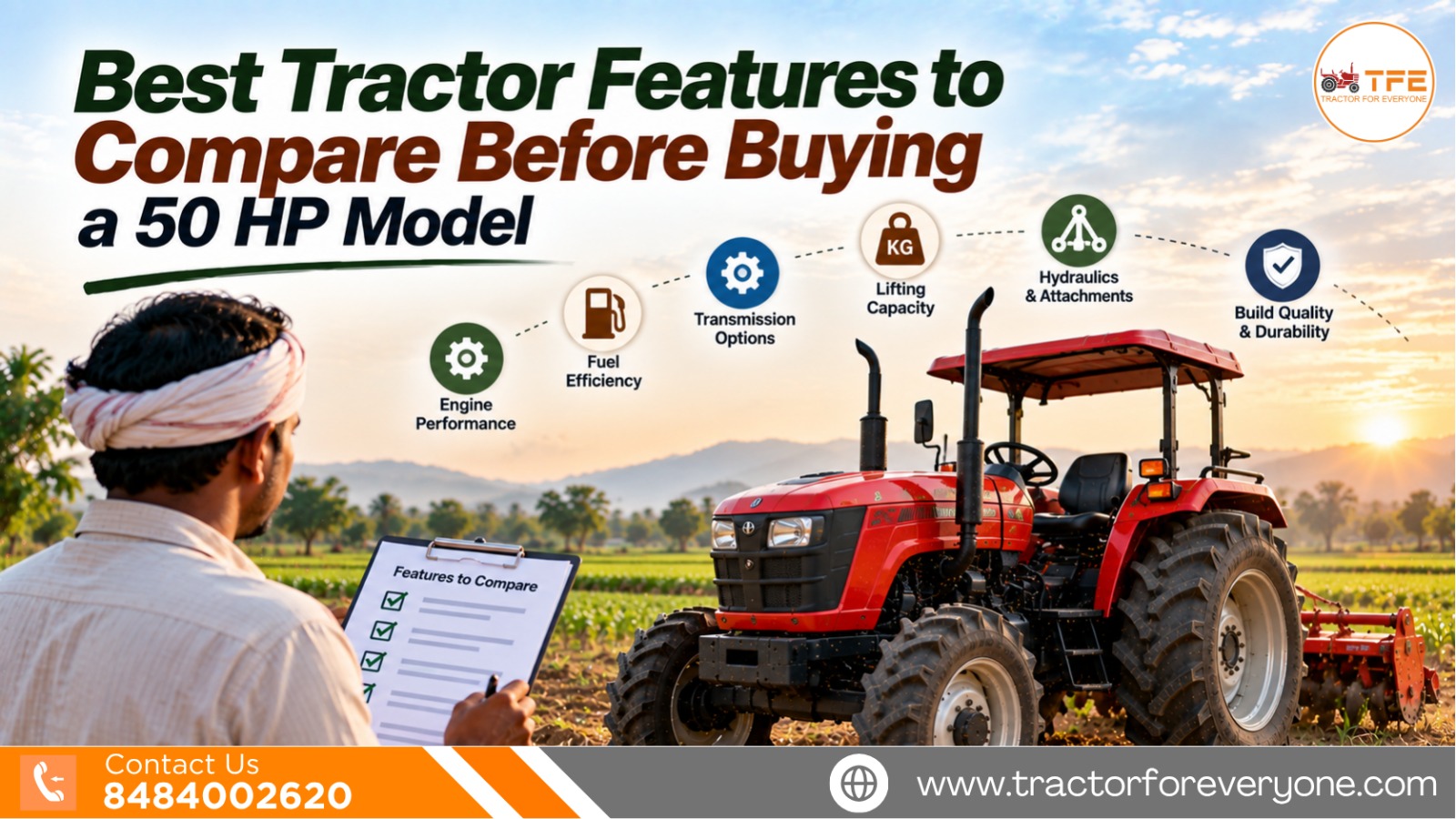
A 50 HP tractor can handle a wide range of farming operations, but horsepower alone does not determine whether a tractor is suitable for a particular farm. Before buying, compare the engine torque, transmission, PTO performance, hydraulic lift capacity, drive type, tractor weight, fuel efficiency, tyres, operator comfort, implement compatibility and after-sales support.
For Indian farmers, the right 50 HP tractor should match the farm's soil, acreage, crops, implements and working conditions rather than simply offering the highest specification on paper.
The most important 50 HP tractor specifications are engine performance, transmission, PTO, hydraulics, drive type, weight, tyres and fuel capacity. These specifications determine how effectively the tractor can perform fieldwork, haulage and implement-based operations.
| Feature | What to Check | Why It Matters |
|---|---|---|
| Engine | HP, cylinders, torque, rated RPM | Determines pulling performance and workload capability |
| Transmission | Gear count, synchronisation, shuttle | Controls speed selection and field flexibility |
| PTO | PTO HP, 540 RPM, economy modes | Determines implement performance |
| Hydraulics | Lift capacity, draft/position control | Important for mounted implements |
| Drive | 2WD or 4WD | Affects traction and field performance |
| Weight | Operating weight and ballast options | Influences stability and traction |
| Tyres | Size, tread and optional configurations | Affects grip and soil interaction |
| Brakes | Oil-immersed or dry brakes | Important for control and safety |
| Steering | Power steering and turning radius | Improves manoeuvrability |
| Comfort | Seat, controls and ergonomics | Matters during long working hours |
| Technology | Sensors, telematics, digital displays | Can support monitoring and productivity |
Engine displacement, cylinder configuration, torque and rated RPM should be evaluated alongside horsepower. Torque is particularly important when the tractor encounters heavy draft resistance during operations such as ploughing, tillage or soil preparation.
A 50 HP rating tells you the approximate power category, but it does not describe the complete operating character of the engine. Two tractors with similar horsepower can have different torque characteristics, engine configurations and rated RPM.
Transmission determines how efficiently a tractor converts engine power into usable field and transport performance. A suitable gearbox should provide useful speed ranges for ploughing, rotavator work, sowing, spraying, haulage and other applications.
When comparing a 50 HP tractor transmission, check:
A tractor used for multiple implements benefits from having a wider range of practical working speeds. Current 45–60 HP tractor ranges demonstrate how manufacturers use different transmission configurations and gear ratios to target varied agricultural applications.
The PTO transfers engine power to compatible implements such as rotavators, threshers, sprayers, pumps and other PTO-driven equipment. Therefore, PTO power and PTO speed should be compared with the power requirement of your implements.
The standard 540 RPM PTO remains common in agricultural tractors, while some models provide economy PTO or additional PTO speed options. For example, DEUTZ-FAHR's Agromaxx range lists a standard 540 RPM PTO and optional configurations, while its Agrolux range includes 540 and 540 ECO options.
Hydraulic lift capacity determines how effectively a tractor can raise and control mounted implements. Compare the rated lifting capacity with the actual operating weight of your implements, while also considering implement geometry and the manufacturer's recommended limits.
Common hydraulic features to compare include:
Hydraulic capacity can vary considerably even among tractors in similar HP categories. For example, DEUTZ-FAHR lists a 1,500 kg maximum rear lift capacity for its Agromaxx 55–60 range, while other ranges offer higher capacities.
This makes tractor hydraulic lift capacity an important buying criterion for farmers using heavy cultivators, rotavators, seed drills, ploughs or other mounted implements.
The choice between 2WD and 4WD should be based on soil conditions, terrain, crop operations and traction requirements. 4WD can provide additional traction in challenging conditions, while 2WD may be suitable for many conventional field and haulage applications.
The 45–60 HP segment includes both 2WD and 4WD configurations, showing that drivetrain selection is a separate consideration from horsepower.
Tractor weight, tyre dimensions and ground clearance directly influence stability, traction and field usability. A heavier tractor is not automatically better; the ideal configuration depends on soil type, implement load, field conditions and the required traction.
When comparing tractors, check:
Operator comfort is an important productivity consideration because agricultural tractors may be operated for several hours continuously. Power steering, an adjustable seat, accessible controls, effective braking and a practical operator platform can reduce physical effort during long working periods.
Compare:
Modern tractor ranges increasingly combine functional controls with more ergonomic driver environments. Manufacturer specifications for current 45–60 HP tractors also highlight adjustable seating and ergonomic controls.
Technology is becoming an increasingly relevant feature in modern tractor buying decisions. Digital displays, telematics, connected-tractor systems and operating data can help farmers monitor machine usage and maintenance, depending on the model and market.
For example, Mahindra announced connected-tractor technology through Digisense 4G as part of its NOVO range, alongside features such as driving modes and enhanced hydraulic technology.
When comparing technology, focus on whether a feature provides a practical benefit rather than choosing a tractor because it has more electronic functions.
Implement compatibility should be checked before purchasing the tractor. A 50 HP tractor may be suitable for rotavators, cultivators, ploughs, seed drills, sprayers, trailers and other implements, but compatibility depends on the implement's weight, PTO requirement, hydraulic demand and recommended tractor HP.
The tractor should have enough PTO power, hydraulic capacity, traction and stability for the intended implement. Never select an implement solely because its working width appears suitable for a 50 HP tractor.
A 50 HP tractor should be evaluated as a complete agricultural machine rather than as an engine-power number. Engine torque, transmission, PTO, hydraulic lift, drivetrain, weight, implement compatibility and ownership cost should all be considered before making the purchase.
For farmers comparing 50 HP tractor models in India, the most useful approach is to create a specification checklist based on actual farm operations and then compare models against those requirements. Tractor For Everyone can help farmers research tractor specifications, compare models, understand implements and evaluate buying considerations before making an informed purchase.
The most important features are engine torque, transmission, PTO power, hydraulic lift capacity, 2WD or 4WD, tractor weight, tyres, fuel efficiency and implement compatibility. These specifications provide a more complete picture than horsepower alone.
Neither configuration is universally suitable for every farm. 4WD can be useful for wet, uneven or traction-demanding conditions, while 2WD can meet the needs of many farms operating on firm and relatively level land.
There is no single lift-capacity figure that suits every 50 HP tractor. The required capacity depends on the weight, centre of gravity and operating requirements of the implements you intend to use.
540 RPM is a common agricultural PTO speed, but the correct PTO configuration depends on the implements being used. Some tractors also provide economy PTO modes or additional speed options.
Start with your soil type, acreage, crops, terrain and implements, then compare engine torque, transmission, PTO, hydraulics, drivetrain, weight, fuel efficiency, comfort, service support and total ownership cost. The right tractor is the one whose specifications match your actual farming workload.
Popular Blogs View All
Popular Video View All
Best Used Car, Services, Auto Parts, Rent Car Available for Buy and Sell Near By Go Ahead
