
 Sell Your Tractor

Best Used Car, Services, Auto Parts, Rent Car Available for Buy and Sell Near By Go Ahead
.jpeg)
The best tractor for organic farming in India in 2026 is generally a compact, fuel-efficient tractor in the 25–40 HP range that can handle inter-cultivation, seedbed preparation, spraying, light tillage and transport without unnecessarily disturbing the soil. For most organic and natural farming operations, the right tractor should be selected based on farm size, soil condition, crop spacing, implement compatibility, traction and soil-compaction risk, rather than horsepower alone.
Organic farming places greater emphasis on maintaining soil structure, reducing unnecessary chemical inputs and supporting long-term soil health. That does not mean tractors are unsuitable for organic agriculture; instead, tractor selection should focus on controlled field operations and appropriate implements.
There is no single tractor that is best for every organic farm. A 25–35 HP compact tractor is often a practical starting point for small farms, orchards and vegetable cultivation, while farms requiring heavier tillage or larger implements may benefit from a 35–40 HP tractor.
The ideal organic farming tractor should offer:
Suitable horsepower for the farm's implements
Good low-speed control
Efficient PTO operation
Adequate hydraulic lifting capacity
Compact dimensions where crops are planted closely
Suitable tyre configuration
Low soil disturbance for routine operations
Easy access to local servicing and spare parts
Compatibility with organic farming equipment
For narrow-row crops, orchards and vegetable farms, compact tractors can provide better maneuverability than larger utility tractors. John Deere, for example, describes its 3036EN 35 HP as a multipurpose tractor suited to vineyards, vegetable crops and inter-culture operations, with a narrow track width and 910 kgf lifting capacity.
For many small and medium organic farms, 25–40 HP provides a useful balance between implement capability, maneuverability and operating cost. However, the correct HP depends on the soil, acreage, implements and crops being cultivated.
| Farm requirement | Suggested tractor range |
|---|---|
| Orchards and narrow-row crops | 20–30 HP |
| Vegetable cultivation | 25–35 HP |
| Inter-cultivation and spraying | 20–30 HP |
| General organic farming | 25–40 HP |
| Rotavator and moderate tillage | 30–40 HP |
| Larger fields and heavier implements | 40 HP+ |
A larger tractor is not automatically a better organic farming tractor. Excess horsepower can increase purchase and operating costs, while an unnecessarily heavy machine can increase the risk of soil compaction, particularly when field conditions are wet.
The best model depends on the farm operation, but several compact and multipurpose tractors stand out when evaluated for organic farming requirements.
1. Mahindra OJA Series – Best for Small and Diversified Farms
The Mahindra OJA series is worth considering when maneuverability, compact dimensions and modern features are priorities. The range includes compact tractors designed for applications such as orchards, intercropping and small-farm operations.
Mahindra OJA tractors are particularly relevant for farmers managing diversified farms where one tractor may need to handle cultivation, spraying, transport and interculture. Current Indian listings include OJA models in the 20–30 HP category, including the OJA 2124 4WD.
Best suited for:
Vegetables, orchards, intercropping and small holdings.
Why consider it:
Compact dimensions, maneuverability and 4WD availability can make the range useful where field access and traction matter.
The John Deere 3036EN is a 35 HP multipurpose tractor specifically positioned for vineyards, vegetable crops and inter-culture operations. Its narrow design and 4WD configuration make it relevant to farms where maneuverability is as important as pulling power.
The manufacturer lists a 35 HP, three-cylinder engine, 8 forward and 8 reverse gears, and a lifting capacity of 910 kgf. The tractor's narrow track width is designed to provide a low turning radius for orchard and vegetable applications.
Best suited for:
Vegetables, vineyards, orchards and inter-cultivation.
Why consider it:
Its speciality-tractor design aligns well with farms where row spacing and maneuverability are important.
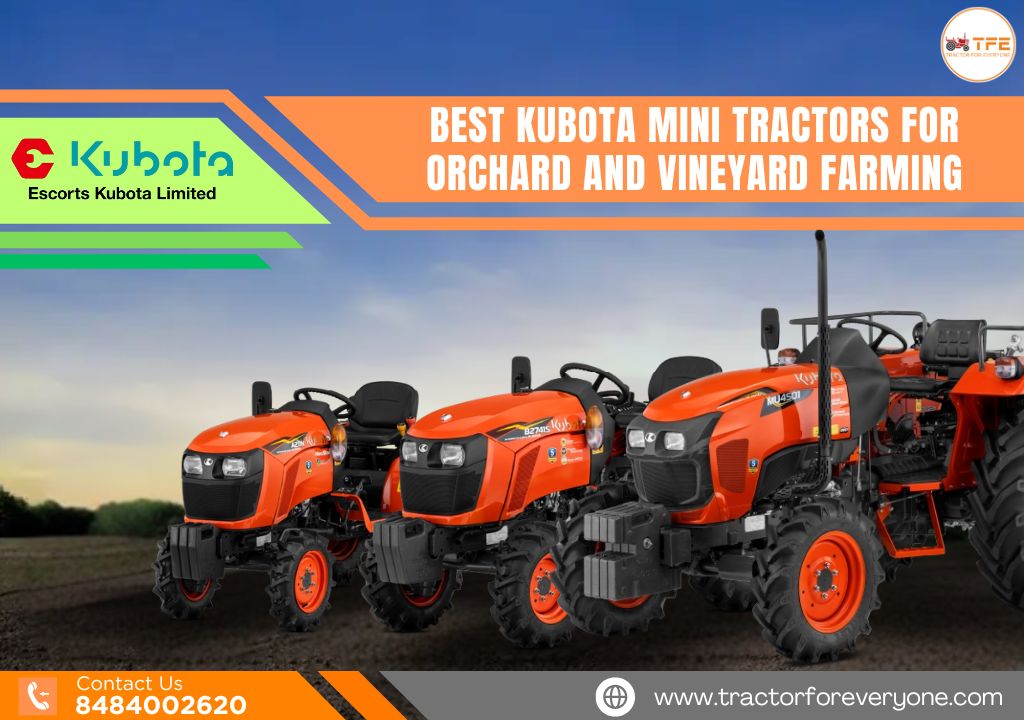
The Kubota NeoStar B2741S is a 27 HP 4WD tractor that fits the compact-tractor category. This type of tractor can be useful for organic farms that need a relatively small machine capable of working across multiple operations.
Current tractor listings place the NeoStar B2741S among the available under-30 HP tractors in India.
Best suited for:
Small farms, orchards, vegetables and light field operations.
Why consider it:
Its compact size and 4WD configuration make it suitable for farms where maneuverability and traction are important.
The Swaraj 724 XM Orchard is a 25–30 HP tractor designed for orchard-oriented applications. Orchard tractors need to balance sufficient power with dimensions that allow them to move between crop rows.
Current 2026 tractor listings place the Swaraj 724 XM Orchard in the 25–30 HP segment.
Best suited for:
Fruit orchards, inter-row cultivation and small farms.
Why consider it:
The orchard-oriented configuration makes it more relevant than a large conventional tractor for farms with restricted row spacing.
The VST Shakti MT 270 Viraat is a 27 HP 4WD tractor positioned in India's compact tractor segment. Current 2026 listings place it among 20–30 HP tractors.
Best suited for:
Small farms, horticulture, light tillage and general utility work.
Why consider it:
The compact 4WD configuration provides an option for farmers looking for traction and maneuverability without moving into a larger tractor category.
4WD is generally preferable when organic farms operate on wet, sloping, loose or difficult terrain, while 2WD can be sufficient for dry, level fields and lighter operations. The decision should be based on field conditions rather than the assumption that 4WD is always superior.
Fields are mostly level
Soil has good traction
Operations are relatively light
The farm uses smaller implements
Initial purchase cost is a major consideration
Fields become slippery during wet conditions
The farm has slopes or uneven terrain
Better traction is required
Heavy PTO or tillage work is performed
The tractor will be used in orchards or difficult field conditions
For example, the John Deere 3036EN is offered with heavy-duty MFWD, while its speciality configuration focuses on narrow-field maneuverability.
Tractor weight matters because repeated traffic can contribute to soil compaction, particularly when machinery operates on wet soil. Organic farmers should therefore consider the tractor's size, tyre configuration, field traffic pattern and operating conditions alongside horsepower.
A practical approach is to avoid unnecessary field passes and operate machinery when soil moisture is suitable. Wider tyres or appropriate tyre pressure can also help distribute the machine's load over a larger area.
The goal is not simply to buy the lightest tractor. Instead, choose a tractor that provides enough traction and lifting capacity for the required implements without being unnecessarily oversized for the farm.
A tractor becomes more useful in organic agriculture when it is matched with implements that support soil preparation, sowing, interculture and residue management.
Common organic farming equipment includes:
Cultivators
Rotavators
Seed drills
Ridgers
Inter-row cultivators
Mulching equipment
Sprayers
Disc harrows
Trailers
Residue-management implements
Implement selection should match tractor PTO power, hydraulic capacity and operating width. For example, a small 25 HP tractor should not be paired with an implement designed for a substantially higher-power tractor simply because the implement is available.
A low input farming tractor is not a separate technical category of tractor. The term generally describes a tractor selected to perform necessary farm operations efficiently while keeping machinery, fuel and maintenance costs appropriate to the farm's production system.
For low-input organic farming, prioritize:
Correct horsepower
Fuel efficiency
Implement compatibility
Reliable hydraulics
Simple maintenance
Local service availability
Suitable traction
Compact dimensions where required
The cheapest tractor is not necessarily the lowest-cost tractor over its working life. Fuel consumption, maintenance, implement requirements, downtime and resale value should also be considered.
A tractor for natural farming should support minimum and timely soil disturbance rather than encourage unnecessary tillage. Natural farming systems can therefore benefit from tractors that work efficiently with appropriate implements and require fewer field passes.
Look for:
Good low-speed operation
Efficient PTO performance
Compact dimensions
Suitable hydraulic capacity
Easy implement attachment
Good traction
Fuel-efficient operation
Reliable local service
The tractor should be viewed as a tool within the farming system, not as the farming system itself.
Before purchasing, compare the tractor against the actual operations performed on your farm.
Small holdings generally do not require the same tractor size as large commercial farms. A compact tractor can be more practical when most operations involve vegetables, orchards or intercropping.
Write down every implement you currently use or expect to purchase. Then check the manufacturer's recommended tractor horsepower and PTO requirements.
Heavy clay soil, sandy soil and wet fields place different demands on traction and drawbar performance.
Narrow-row crops and orchards require better maneuverability and suitable tractor dimensions.
Select 4WD when traction requirements justify the additional cost. Otherwise, a suitable 2WD tractor may provide adequate performance.
A tractor is a long-term capital purchase. Dealer availability, spare parts, maintenance support and technician access can influence total ownership cost.
Do not compare tractors only by purchase price. Consider fuel, maintenance, financing, insurance, implements, downtime and resale value.
| Requirement | Suitable choice |
|---|---|
| Small organic farm | 20–30 HP compact tractor |
| Vegetable farming | 25–35 HP compact/speciality tractor |
| Orchard farming | 25–35 HP orchard/narrow tractor |
| General organic farming | 25–40 HP utility tractor |
| Wet or difficult terrain | 4WD tractor |
| Narrow-row farming | Compact/narrow-track tractor |
| Moderate tillage | 30–40 HP tractor |
| Low-input operation | Efficient tractor matched to implements |
For most small and medium organic farms, a 25–35 HP compact tractor is a strong starting point because it balances maneuverability, implement compatibility and operating efficiency. Farmers with heavier soil, larger acreage or more demanding tillage can move toward the 35–40 HP category.
There is no universal “best tractor for organic farming.” A farmer growing vegetables between narrow rows may benefit more from a compact 4WD tractor, while a mixed farm with heavier tillage requirements may need additional horsepower.
Among the models discussed, the Mahindra OJA series is worth evaluating for compact and diversified farms, the John Deere 3036EN for vegetable and inter-culture operations, the Kubota NeoStar B2741S for compact 4WD applications, the Swaraj 724 XM Orchard for orchard farming and the VST Shakti MT 270 Viraat for compact utility work.
The final purchase decision should be based on farm size, crop type, soil condition, implement requirements, tractor dimensions, drivetrain, local service support and total ownership cost rather than brand name or horsepower alone.
Popular Blogs View All
Popular Video View All
Best Used Car, Services, Auto Parts, Rent Car Available for Buy and Sell Near By Go Ahead
