
 Sell Your Tractor

Best Used Car, Services, Auto Parts, Rent Car Available for Buy and Sell Near By Go Ahead
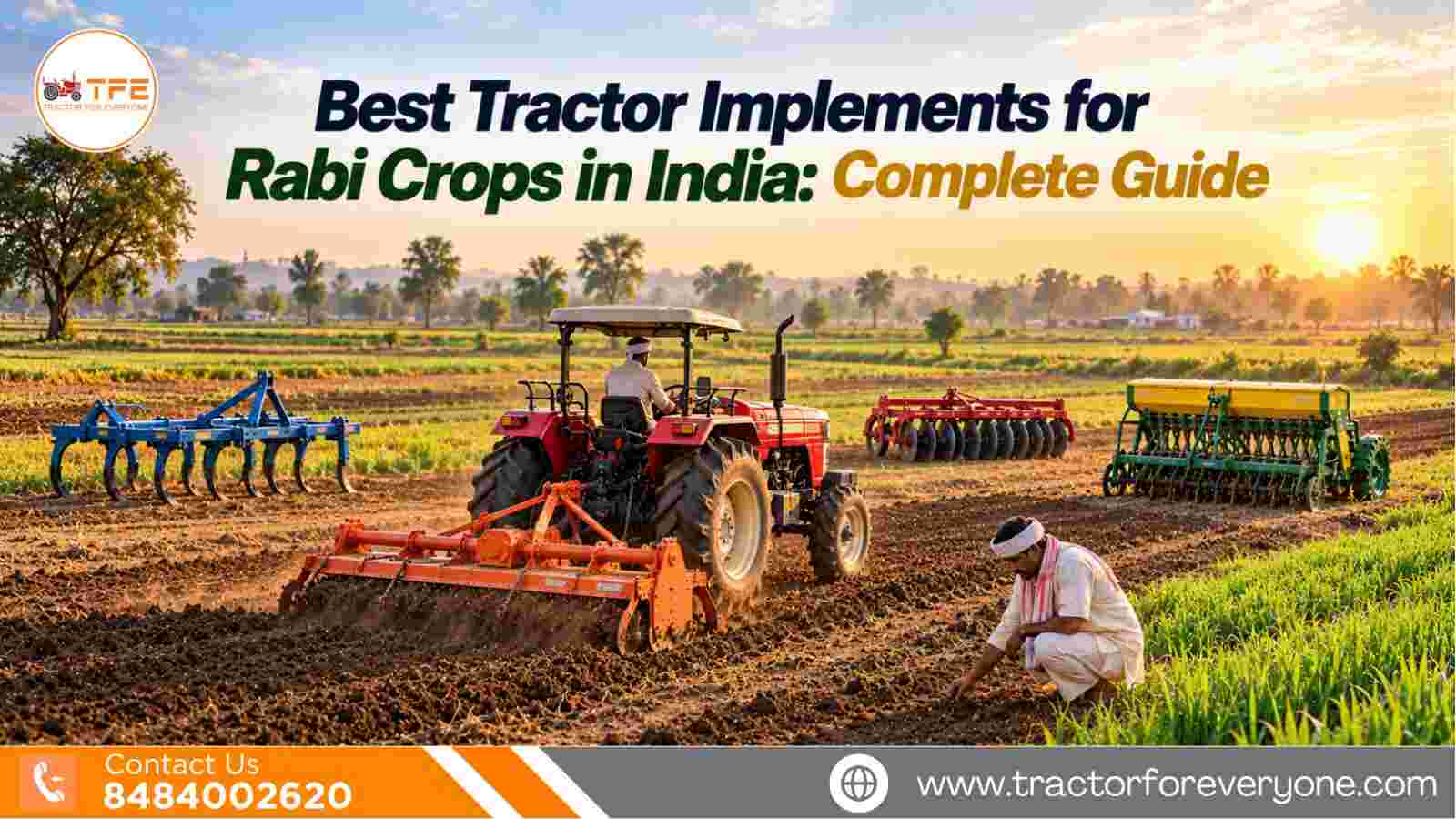
Rabi crops such as wheat, mustard, chickpea (gram), peas and lentils benefit from timely field preparation, accurate sowing, effective weed control and well-managed irrigation. The best tractor implements for Rabi crops in India depend on the crop, soil type, available moisture, tractor power, farm size and whether the field uses conventional tillage or a conservation-farming method.
For most farms, useful implements include a cultivator or plough for land preparation, a seed drill for sowing, a zero-till drill or Happy Seeder for suitable rice-wheat systems, a sprayer for crop protection and a trailer for transporting farm inputs and produce. Farmers should select each implement according to the job it needs to perform—not simply by price or tractor horsepower.
Tractor implements help farmers complete essential Rabi operations on time and with more consistent field coverage. Appropriate mechanisation can reduce manual effort and improve the efficiency of seed placement, soil preparation and crop protection.
The Rabi season generally includes winter crops such as wheat, mustard, chickpea, lentil and peas. The sowing window and field requirements vary by region, crop variety, soil moisture and local weather.
Using suitable agricultural implements can help farmers:
Prepare a suitable seedbed where conventional tillage is required.
Place seeds at a more consistent depth and spacing.
Apply fertiliser and crop-protection products more uniformly when the equipment is designed for the task.
Reduce repeated tractor passes when an appropriate combined-operation implement is used.
Save time during busy sowing and crop-management periods.
Manage crop residues using suitable conservation-agriculture equipment.
The best implement is the one suited to a particular farm operation and crop. Before purchasing equipment, compare its working width, tractor power requirement, soil suitability, maintenance needs and expected annual use.
A tractor cultivator loosens and works the soil using tines. It is commonly used for seedbed preparation, breaking up suitable soil surfaces and controlling small weeds before sowing.
Best suited for: Wheat, mustard, chickpea and other Rabi crops where cultivation is recommended.
Key selection points:
Match the number of tines and working width to tractor power.
Consider soil texture, compaction and field residue.
Check tine strength, frame quality and availability of replacement parts.
Avoid unnecessary repeated cultivation that can waste fuel or damage soil structure.
A cultivator is not a substitute for every tillage implement. Hard, compacted or residue-heavy fields may require a different operation or a combination of implements based on field conditions.
A mouldboard (MB) plough cuts and turns soil. It may be useful when primary tillage is required to bury certain residues or manage a field that needs deeper soil disturbance.
Best suited for: Fields where soil conditions and the crop plan justify primary tillage.
Before using an MB plough, assess soil moisture and the depth of tillage required. Excessive or poorly timed ploughing can increase fuel consumption and leave large clods that require additional seedbed preparation. Not every Rabi field needs deep ploughing every season.
A tractor-mounted rotavator uses rotating blades to break and mix soil. It can prepare a fine seedbed in suitable conditions and may reduce the number of separate tillage passes.
Best suited for: Farms that need rotary soil preparation before sowing and where the soil and residue conditions suit the machine.
When choosing a rotavator, check the tractor's rated power, PTO compatibility, working width, gearbox, blade quality and operating depth. A wider or heavier rotavator is not automatically better: it may demand more power and fuel. Avoid repeated pulverisation, particularly when the soil is too wet, because it can damage soil structure.
A seed drill places seed in rows at a controlled depth and spacing. A seed-cum-fertiliser drill can also place fertiliser in a separate, designed position, helping make sowing more consistent when properly calibrated.
Best suited for: Wheat, mustard, chickpea and other crops when the drill is designed or adjusted for the crop's seed size and row-spacing requirements.
Check the following before sowing:
Seed-metering mechanism and calibration.
Furrow openers and depth-control wheels.
Row spacing and seed-rate settings.
Seed and fertiliser box condition.
Tractor compatibility and field capacity.
Always calibrate the machine before entering the field. Incorrect settings can lead to uneven plant populations, seed wastage or poor crop establishment. Follow the crop-specific seed rate and sowing-depth recommendations provided by the relevant agricultural university or local extension service.
A zero-till seed drill places wheat seed into suitable untilled soil, allowing farmers to avoid conventional seedbed preparation where the field and cropping system are appropriate. It is particularly relevant in some rice-wheat systems in north-western India.
Best suited for: Suitable fields after rice harvest where soil moisture, residue conditions, machine setup and local recommendations support zero-tillage.
Potential advantages include fewer field passes, reduced time spent preparing the seedbed and lower tillage-related costs. However, a zero-till drill is not suitable for every field. Farmers should confirm residue-management requirements, soil moisture and weed-management plans before adopting the method.
A Happy Seeder is designed to sow wheat in suitable fields with retained rice residue. It can help establish a crop without the same conventional residue-clearing and seedbed-preparation sequence used in other systems.
Best suited for: Appropriate rice-wheat fields where the machine, residue load, tractor and local agronomic practices are compatible.
The benefits depend on correct machine adjustment, field conditions and residue distribution. Before purchasing, check the required tractor power, local service availability, blade and component replacement costs, and whether the machine is suitable for the farm's residue-management method.
A tractor-mounted or tractor-operated sprayer applies crop-protection products when treatment is required. Depending on the equipment, it may be used for suitable herbicide, fungicide or insecticide applications.
Best suited for: Rabi fields that require timely and uniform crop-protection treatment.
Choose a sprayer based on tank capacity, nozzle type, pump performance, boom width, filtration and ease of cleaning. Use only products approved for the crop and target problem, and follow the label for dose, water volume, protective equipment, weather restrictions and re-entry instructions. Avoid spraying in unsuitable wind conditions or near sensitive crops and water sources.
Fertiliser applicators and seed-cum-fertiliser drills help place nutrients according to the equipment design and crop plan. They can improve placement consistency when calibrated correctly.
Best suited for: Farms where the crop's nutrient-management plan calls for mechanised fertiliser application or combined sowing and fertiliser placement.
Use soil-test results and locally recommended nutrient rates to guide application. Do not assume that every fertiliser can be placed directly beside seed; the safe placement distance and application method depend on the crop, fertiliser and machine.
A tractor trailer helps transport seed, fertiliser, harvested produce and other farm materials between fields, storage areas and markets.
Best suited for: Farms that regularly move inputs or produce and have safe access routes.
Check the trailer's rated payload, braking system, tyre condition, hitch compatibility and road-use requirements. Never exceed the rated load or tow a trailer that the tractor cannot safely control, particularly on slopes or public roads.
The correct implement combination depends on crop requirements and local conditions. The following table is a starting point, not a universal prescription.
| Rabi crop or operation | Commonly useful implements | Main purpose |
|---|---|---|
| Wheat after conventional field preparation | Cultivator or suitable plough, seed drill, sprayer | Prepare soil, sow in rows and manage crop protection |
| Wheat after paddy in a suitable field | Zero-till drill or Happy Seeder | Establish wheat with reduced conventional tillage |
| Mustard | Suitable cultivator, seed drill or planter, sprayer | Prepare the field, place small seeds accurately and manage crop protection |
| Chickpea (gram) | Suitable seed drill, cultivator where required, sprayer | Establish the crop and support weed and pest management |
| Lentil and peas | Crop-compatible seed drill or planter, sprayer | Maintain appropriate seed placement and crop care |
| General farm transport | Properly rated tractor trailer | Move farm inputs and produce |
Always verify crop-specific row spacing, seed rate and sowing depth using local agricultural recommendations. The same implement may need different settings for different crops.
Farmers should assess compatibility and total operating cost before purchasing a tractor implement. Tractor horsepower alone does not determine whether a machine is suitable.
Use this checklist:
Identify the operation: Decide whether the main need is tillage, sowing, residue management, spraying or transport.
Check tractor compatibility: Confirm the implement's recommended power range, hitch category, PTO requirements and hydraulic capacity, where applicable.
Match the soil and crop: Clay, sandy and residue-heavy fields can require different implement designs and operating settings.
Compare working width and field capacity: A wider implement may cover more land per pass but can also require more power.
Estimate total ownership cost: Include purchase price, fuel, routine servicing, wear parts, repairs and storage.
Check local service support: Confirm spare-parts availability and access to repair technicians before buying.
Consider renting: If an implement is used only briefly each year, a custom hiring centre or local rental service may be more economical than ownership.
The required tractor power varies with implement design, working width, soil condition, operating depth and field conditions. There is no single horsepower figure that applies to every cultivator, rotavator, seed drill or sprayer.
Before buying, consult the tractor and implement manufacturers' specifications. Confirm PTO speed and power for PTO-driven machines, and check hydraulic lift capacity for mounted implements. For heavy equipment, also consider tractor stability, ballast recommendations and safe transport requirements.
Do not select an implement based only on a seller's broad horsepower claim. Ask for the exact model's recommended power range and, where possible, arrange a demonstration in similar field conditions.
For many Rabi farms, a suitable seed drill, a cultivator for fields that need tillage, and a sprayer for necessary crop protection form a practical starting combination. Farms growing wheat after paddy may also consider a zero-till drill or Happy Seeder if their field and residue conditions are suitable.
A rotavator, MB plough, fertiliser applicator or trailer should be selected according to the farm's actual operations rather than purchased as a standard package. Before buying, compare manufacturer specifications, check tractor compatibility and calculate whether ownership or custom hiring offers better value.
Tractor For Everyone helps farmers research tractors and agricultural equipment. Use the platform to compare relevant tractor options and gather the information needed to make a more informed farm-machinery decision.
Popular Blogs View All
Popular Video View All
Best Used Car, Services, Auto Parts, Rent Car Available for Buy and Sell Near By Go Ahead
