
 Sell Your Tractor

Best Used Car, Services, Auto Parts, Rent Car Available for Buy and Sell Near By Go Ahead
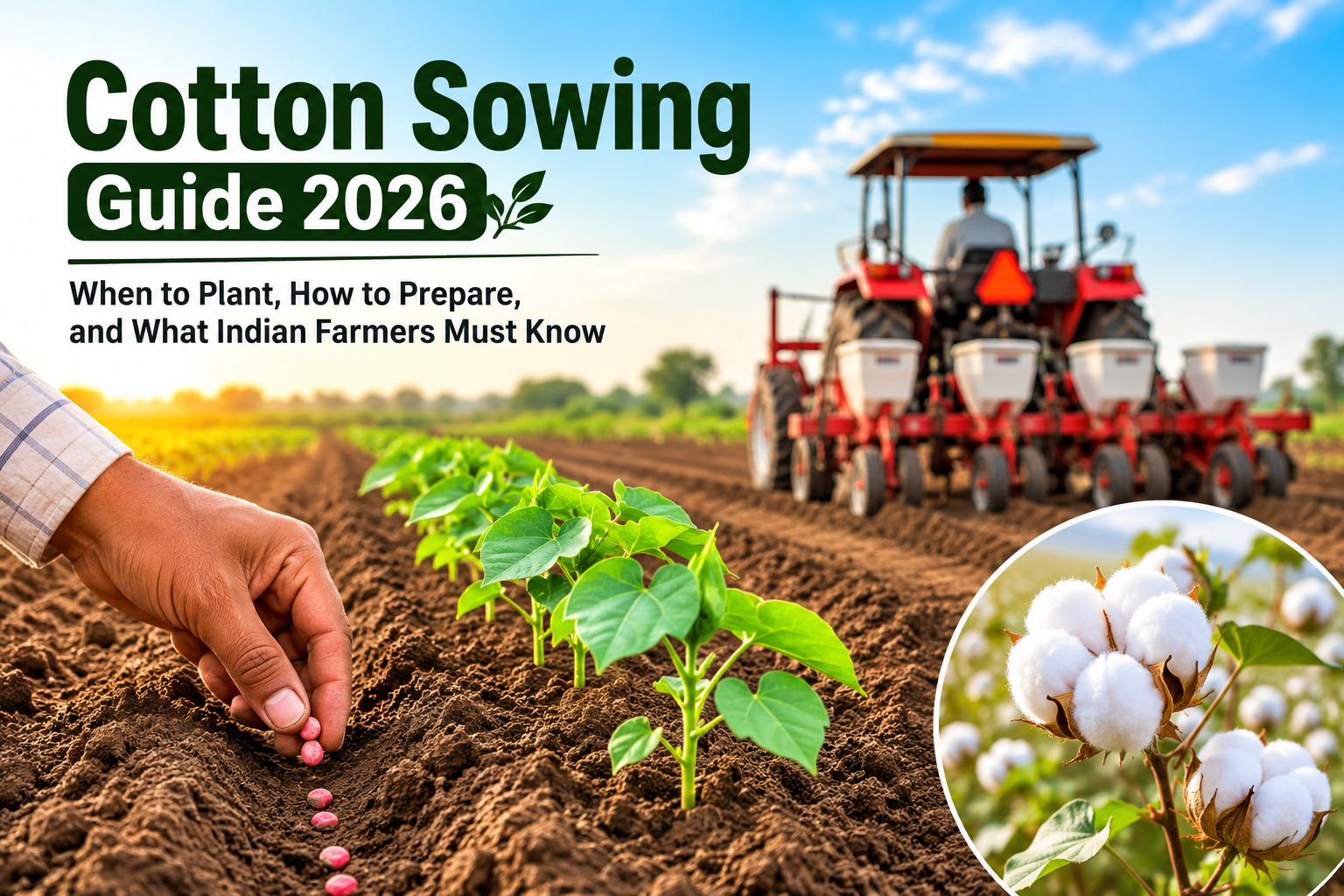
Cotton sowing in India in 2026 should ideally begin between the last week of May and the second week of June, once pre-monsoon showers have provided 50–100 mm of soil moisture. Sowing too early in dry soil or too late after peak monsoon arrival both reduce germination rates and final yield.
Cotton is the single most important kharif cash crop for farmers across Maharashtra, Gujarat, Telangana, Punjab, and Haryana. This guide covers every stage from soil preparation to seed selection, spacing, and post-sowing care — giving Indian farmers a clear, step-by-step plan for the 2026 kharif season.
The best time to sow cotton in India is when soil temperature is consistently above 18°C and the first pre-monsoon or early monsoon rain has delivered at least 50 mm of moisture. Across most cotton-growing states, this window falls between late May and mid-June.
Region-wise sowing calendar for 2026:
Sowing outside this window — particularly after 15 July — significantly shortens the crop's boll-development period, reducing yield potential by 20–30%.
Cotton grows best in deep, well-drained black cotton soil (Vertisols) or medium loamy soil with a pH of 6.0–8.0. Proper tillage and field levelling before sowing directly affect water retention, root penetration, and boll quality at harvest.
Step-by-step soil preparation:
Tractors fitted with chisel ploughs or reversible disc ploughs work best for deep cotton tillage. Farmers looking for tractor models suited to black cotton soil can compare specifications and prices on TractorForEveryone.com, which lists verified tractor options by HP range and soil-type application.
The right cotton seed for 2026 is a certified Bt hybrid variety approved by your state's agriculture department, suited to your soil type and rainfall pattern. Bt cotton hybrids now account for over 95% of cultivated area in India and offer built-in resistance to the American bollworm (Helicoverpa armigera).
Key criteria for cotton seed selection:
Cotton should be sown at a depth of 3–5 cm, with a seed rate of 1.0–1.5 kg per acre for Bt hybrid seeds (supplied in 450 g packets per hybrid pack). Proper spacing between plants and rows is just as important as sowing depth because cotton is a light-hungry crop — overcrowding reduces boll development significantly.
Recommended spacing:
| Farming System | Row-to-Row | Plant-to-Plant |
|---|---|---|
| Rainfed (normal) | 90 cm | 60 cm |
| Irrigated / high-fertility | 90–120 cm | 45–60 cm |
| Wide-row paired planting | 150 + 30 cm | 60 cm |
| High-density planting (HDP) | 67.5 cm | 45 cm |
High-density planting is gaining popularity in Gujarat and parts of Haryana because it allows mechanised harvesting and cuts per-plant input cost, even though it requires a different variety with a compact plant architecture.
Cotton has a high nutrient demand, and balanced fertilisation at the right growth stages is one of the biggest yield levers a farmer can pull. The recommended NPK dose for Bt hybrid cotton is 120:60:60 kg per hectare, split across three applications.
Application schedule:
Micronutrients — especially boron and zinc — are frequently deficient in cotton-growing black soils and should be applied either as a soil dose or foliar spray at boll setting.
The three pests Indian cotton farmers must monitor most closely in 2026 are pink bollworm, whitefly, and sucking pests (aphids, jassids, and thrips) in the early vegetative stage. These three account for the majority of preventable yield losses in kharif cotton.
Monitoring checklist:
Avoid calendar-based pesticide spraying. Threshold-based application reduces cost and chemical resistance buildup — both outcomes that protect the next season's performance.
Cotton is semi-drought tolerant once established but needs timely irrigation at two absolutely critical stages: square initiation (40–50 DAS) and boll development (80–100 DAS). Missing irrigation at either of these stages causes irreversible yield loss, particularly in rainfed fields that experience a mid-season dry spell.
Irrigation guide:
Drip irrigation reduces water use by 30–40% compared to flood irrigation and is now subsidised under PM-KUSUM and various state horticulture board schemes for cotton farmers.
The first 30 days after sowing are the most fragile period in a cotton crop's life cycle. Three practices in this window directly determine whether a field reaches its full plant population by the time the crop enters its rapid growth phase.
Tractor-mounted inter-row cultivators suited to 90 cm row spacing are available across all major implement brands, and specifications can be checked alongside compatible tractor models on Tractor For Everyone
A successful 2026 kharif cotton season starts with the right sowing window (late May to mid-June), a certified Bt hybrid suited to your region, and disciplined soil preparation before the first seed goes into the ground. From seed to harvest, cotton responds more clearly to timing decisions than almost any other kharif crop — which makes this sowing guide a practical reference point for Indian farmers at every scale.
Popular Blogs View All



Popular Video View All


Best Used Car, Services, Auto Parts, Rent Car Available for Buy and Sell Near By Go Ahead
