
 Sell Your Tractor

Best Used Car, Services, Auto Parts, Rent Car Available for Buy and Sell Near By Go Ahead
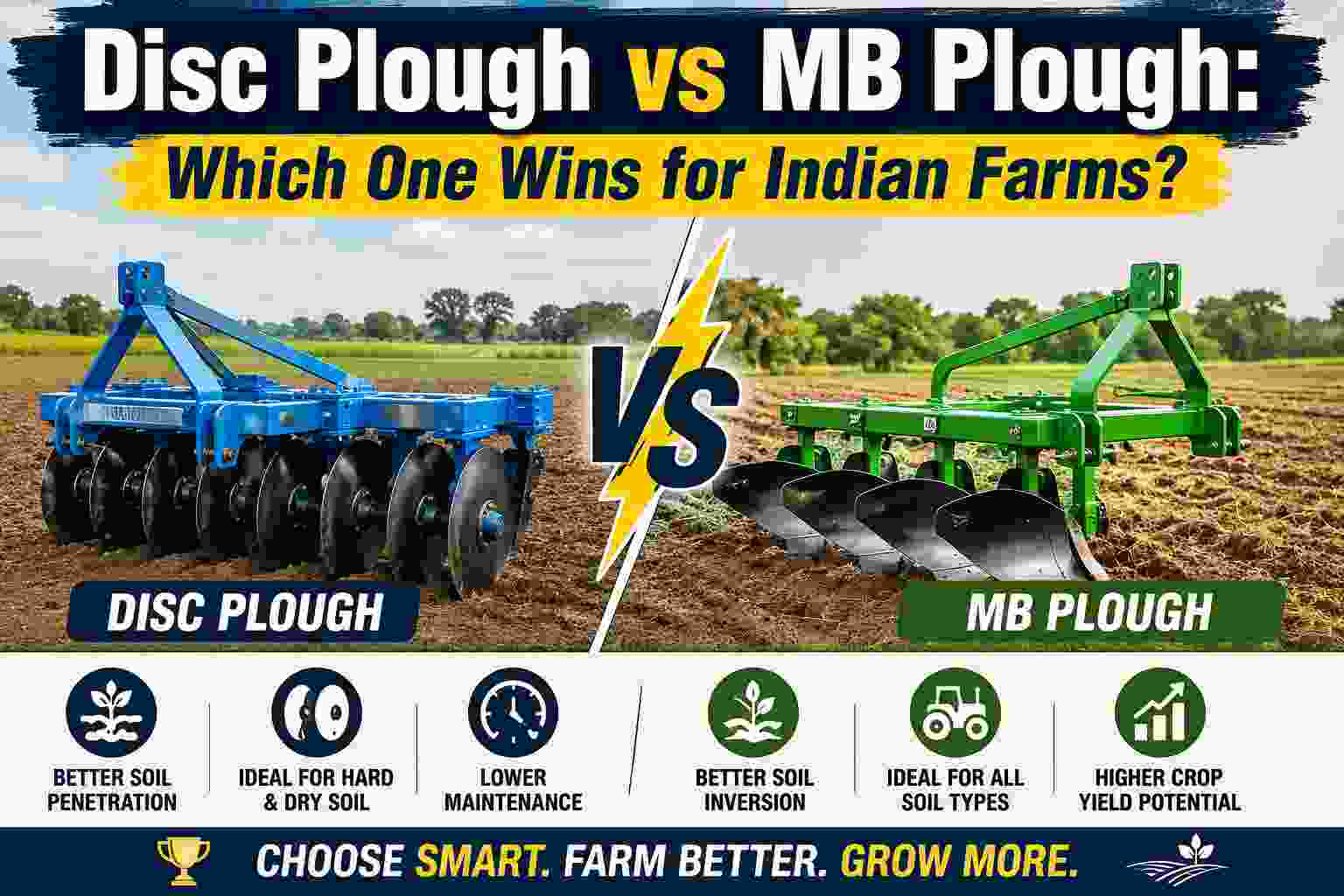
Disc ploughs work better for hard, dry, stony, or residue-heavy soil and for monsoon-season ploughing because the rotating discs shed mud instead of clogging. MB (mouldboard) ploughs work better for soft-to-medium, stone-free soil where deep, uniform inversion and complete residue burial matter more than speed. Neither plough is universally "better" — the right choice depends on your soil type, rainfall pattern, and crop residue load.
This guide compares both ploughs across nine practical factors so you can choose with confidence before the next ploughing season.
A disc plough is a primary tillage implement that uses large, concave steel discs instead of a fixed blade to cut and turn soil. Each disc rotates as the tractor pulls it forward, slicing a furrow and tumbling the soil sideways rather than sliding through it.
Key characteristics:
The discs roll rather than slide, which is what gives this plough its main advantage: it pushes through obstacles like stones, stumps, and crop stubble instead of jamming against them.
Disc ploughs are widely used across Indian states with black cotton soil, sandy soil, and red soil — particularly where farmers face hard, sun-baked land after harvest or sticky clay during early monsoon showers. Because the discs cut at an angle and tilt rather than driving straight in, operators can adjust the working width and depth without changing the implement, which adds flexibility across different field sections in the same plot.
An MB plough is a tillage implement with a curved steel mouldboard and a sharp share that slices a continuous strip of soil, lifts it, and flips it completely upside down. This is the older, more traditional plough design and is still the standard choice for deep, clean tillage in stone-free fields.
Key characteristics:
Because the mouldboard fully inverts the soil slice, it buries weed seeds and crop residue more completely than a disc plough — but that same rigid blade is also why it breaks more easily on rocky or root-heavy land.
MB ploughs remain the standard choice for farmers preparing seedbeds for row crops, since the deeper, uniform furrow improves aeration and gives roots more loosened soil to grow into. Many MB ploughs in India are also available in reversible designs, which flip the mouldboard at the end of each pass so the tractor doesn't need to turn back across unploughed land — a small but meaningful fuel and time saving on long, narrow fields.
| Factor | Disc Plough | MB Plough |
|---|---|---|
| Best soil type | Hard, dry, sticky, stony | Medium, soft, stone-free |
| Monsoon/wet field performance | Excellent — discs shed mud | Poor — blade clogs in wet clay |
| Residue & stubble handling | Very good, low clogging | Struggles with heavy residue |
| Soil inversion | Partial (tumbling action) | Complete (full flip) |
| Working depth | Shallower (10–18 cm) | Deeper (15–23 cm) |
| Weed seed burial | Moderate | Strong |
| Durability on rocky/root land | High — discs roll over obstacles | Low — blade can snap or bend |
| Maintenance | Lower; fewer wear points | Moderate; share needs regular sharpening |
| Typical price range in India | Slightly higher per disc unit | Generally more affordable for basic models |
| Fuel/power demand | Moderate | Moderate to high at full depth |
For monsoon ploughing in India, the disc plough is almost always the safer choice. Wet, sticky clay tends to cling to a mouldboard's flat blade, causing it to clog and drag, while a disc plough's rotating action throws soil clear and keeps moving.
This matters because a large share of Indian farmers plough either right before the monsoon (to prepare seedbeds for kharif sowing) or just after early rains soften hard summer soil. In both scenarios:
If your land is mostly black cotton soil, sandy loam, or red soil with seasonal waterlogging, a disc plough will usually save more downtime during the monsoon window than an MB plough.
It's worth noting that disc ploughs are not entirely maintenance-free in monsoon use — scrapers and bearings should be checked more frequently when working consistently wet fields, since moisture accelerates wear on moving parts. But this maintenance is generally far less disruptive than the repeated clogging and clearing an MB plough demands in the same conditions.
An MB plough is the stronger option when your land is relatively stone-free and you need complete inversion rather than speed or stubble-clearing. This applies in three common situations:
Upfront price varies by brand, disc/share count, and tractor compatibility, but two general patterns hold across most Indian dealer listings:
Over a multi-year ownership period, total cost of ownership often evens out — the disc plough saves on breakage-related downtime, while the MB plough saves on the initial purchase price.
Use this checklist to match the plough to your field conditions rather than to brand preference alone:
Many larger Indian farms running mixed soil types keep both implements and switch based on season and field condition rather than committing to one permanently.
There is no single "better" plough between the disc plough and MB plough — each is engineered for different soil and weather conditions. For monsoon-prone, stony, or residue-heavy land common across much of India, the disc plough generally performs more reliably. For stone-free fields where deep inversion and weed control matter most, the MB plough remains the stronger traditional choice.
The most efficient approach for most Indian farmers is matching plough type to field condition each season, rather than treating this as a one-time, permanent decision.
Neither is universally better — a disc plough suits hard, dry, stony, or wet monsoon soil, while an MB plough suits soft, stone-free fields needing deep, complete soil inversion. The right choice depends on your specific soil type and the season you're ploughing in.
Yes, disc ploughs are generally the better option for monsoon or wet soil because the rotating discs shed sticky mud instead of clogging, unlike a fixed mouldboard blade. This makes them a common choice for farmers ploughing right after early rains.
Disc ploughs tend to be more durable on stony or root-infested land because the discs roll over obstacles instead of striking them directly. MB ploughs use a rigid blade that is more likely to bend or break under the same conditions.
Yes, an MB plough generally provides stronger weed control because it fully inverts the soil slice, burying weed seeds deeper than a disc plough's partial tumbling action.
Basic MB ploughs are often cheaper to purchase initially, while disc ploughs tend to need less frequent repair on rough or stony land. Over several years of use, total ownership cost often balances out between the two, depending on field conditions.
Popular Blogs View All


Popular Video View All
Best Used Car, Services, Auto Parts, Rent Car Available for Buy and Sell Near By Go Ahead
