
 Sell Your Tractor

Best Used Car, Services, Auto Parts, Rent Car Available for Buy and Sell Near By Go Ahead
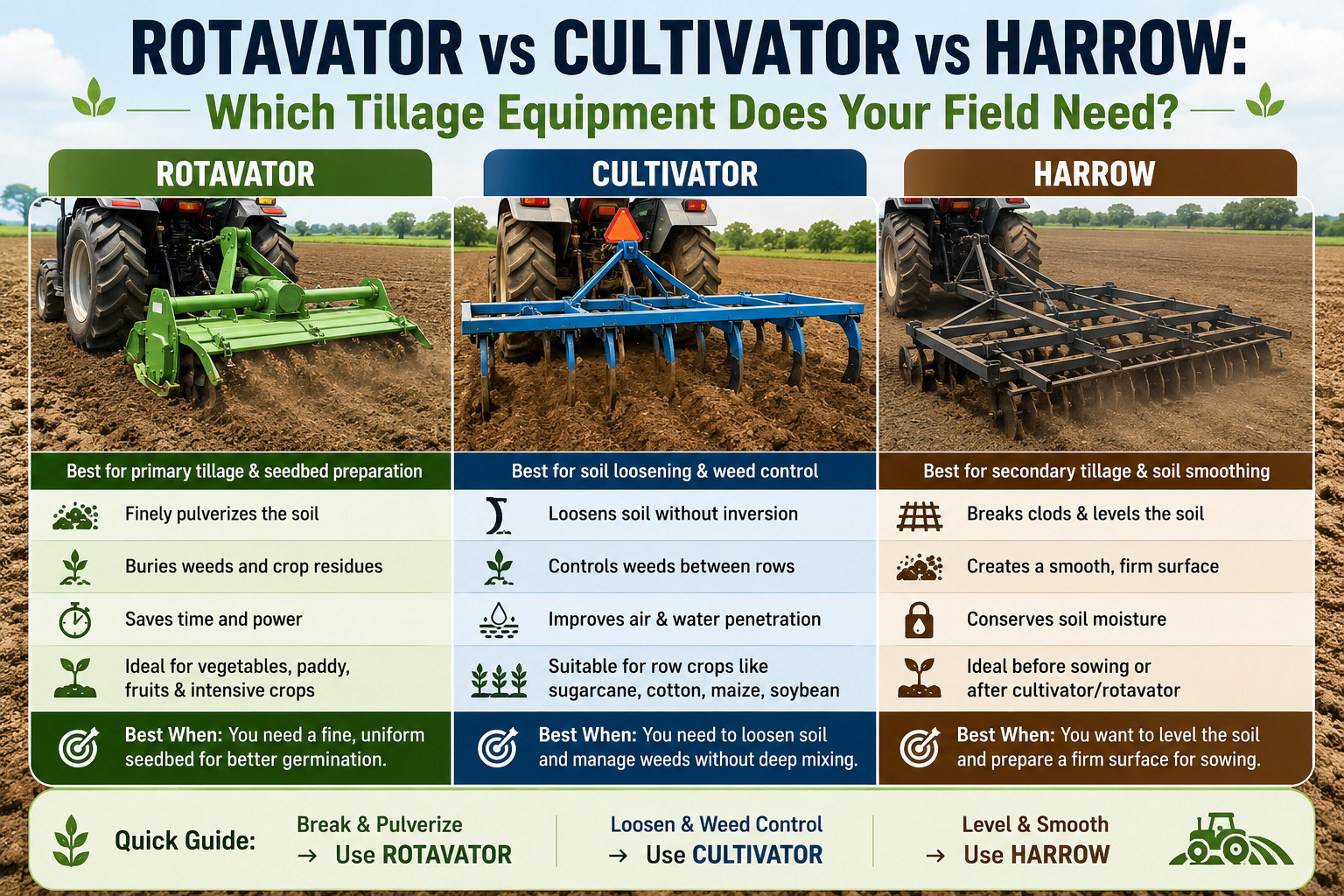
A rotavator, cultivator, and harrow all prepare soil for farming, but they work at different depths and different stages of the cropping cycle. A rotavator digs deep (6–12 inches) to break new or hard ground before sowing, a cultivator works shallow (3–6 inches) to loosen topsoil and manage weeds, and a harrow smooths and pulverizes soil after primary tillage to create a fine seedbed. Choosing the right one — or the right combination — depends on your soil condition, the crop you're growing, and where you are in the farming cycle.
This guide breaks down each implement in plain terms, compares them side by side, and helps you decide what fits your field, your tractor's horsepower, and your budget.
A rotavator (rotary tiller) is a PTO-driven implement with rotating blades that cut, lift, and mix soil in a single pass. It is the go-to choice for breaking compacted or virgin land and creating a fine seedbed before sowing.
Key characteristics:
Because the blades rotate rather than just drag through soil, a rotavator can do in one pass what a plough and harrow might need two or three passes to achieve. This is why it's widely used across Indian wheat, soybean, and vegetable belts where quick turnaround between crops matters.
A cultivator is a lighter implement that loosens topsoil and uproots weeds without disturbing deeper soil layers. It's a secondary tillage tool, most often used after ploughing or rotavating, and sometimes between crop rows during the growing season.
Key characteristics:
Cultivators are cheaper to buy, simpler to maintain, and use less fuel per acre than rotavators. They're the right tool when soil is already broken in and just needs a touch-up before sowing, or when you need to manage weeds in standing rows without disturbing crop roots.
A harrow is a heavy frame fitted with discs, spikes, or tines that smooths and pulverizes soil after primary tillage. It excels at breaking down clods left by ploughing and managing crop residue, especially across large or rocky fields.
Key characteristics:
There are several harrow types — disc harrows, tine/chain harrows, and power harrows — each suited to different soil and residue conditions. Disc harrows are the most common in Indian farming because they handle stubble and hard clods efficiently across wide areas.
| Parameter | Rotavator | Cultivator | Harrow (Disc) |
|---|---|---|---|
| Tillage stage | Primary (sometimes secondary) | Secondary | Primary or secondary |
| Working depth | 6–12 inches | 3–6 inches | 2–5 inches |
| Mechanism | Rotating PTO-driven blades | Fixed/spring tines, towed | Rows of rotating discs, towed |
| Best soil condition | Hard, compacted, or virgin land | Already loosened soil | Ploughed land with clods/residue |
| Primary purpose | Deep tilling + residue mixing | Weed control + aeration | Clod-breaking + leveling |
| Fuel/power need | High | Low to moderate | Moderate to high |
| Typical tractor HP | 35–75 HP | 25–45 HP | 35–60 HP |
| Cost & maintenance | Higher cost, more upkeep | Lower cost, simpler upkeep | Moderate to high cost |
Match the tool to your soil and crop stage rather than picking by price alone:
Many Indian farmers combine these implements across the season: harrow or rotavate first to break ground, then cultivate before sowing and between rows as the crop grows. None of the three implements fully replaces the others — they serve different points in the same tillage sequence.
Rotavators carry the highest upfront cost because of their gearbox and rotor assembly, and they also draw more diesel per acre due to PTO load. Cultivators are the most budget-friendly option for small and medium farms, with fewer moving parts and lower spare-part costs. Disc harrows sit in between — their discs are durable but need periodic sharpening and bearing checks, especially in stony or residue-heavy fields.
For farmers comparing models before buying, checking tractor compatibility (HP and PTO speed), blade/disc material (boron steel vs regular steel), and warranty terms on the gearbox or discs will matter more long-term than the sticker price alone.
A rotavator, cultivator, and harrow each solve a different soil-preparation problem: rotavators break ground deep and fast, cultivators refine and weed at shallow depth with lower cost, and harrows smooth and level after primary tillage. The right choice — or right sequence of all three — depends on your soil's starting condition, the crop you're planting, and the horsepower of your tractor. Matching implement to need, rather than defaulting to one tool for every job, is what actually improves yield and saves on diesel and labor over a season.
A rotavator uses PTO-driven rotating blades to till deep (6–12 inches) and is used for primary tillage on hard or new land. A cultivator uses towed tines to till shallow (3–6 inches) and is used for secondary tillage, weed control, and seedbed refinement after the soil is already broken in.
No. A harrow smooths and breaks clods after primary tillage but cannot dig as deep or break truly compacted or virgin soil the way a rotavator can. Most farmers use a harrow after ploughing or rotavating, not as a substitute for either.
A single pass of a rotavator is commonly used before sowing wheat or soybean because it breaks soil and mixes residue in one operation, saving time compared to ploughing followed by harrowing.
Standard rotavators generally need 35 HP or more, with larger models requiring 50–75 HP, while cultivators can operate effectively on tractors with 25–45 HP, making them suitable for smaller tractors.
Yes. Cultivators have a simpler tine-based design with fewer moving parts, so they cost less to maintain and use less fuel per acre than rotavators, which have a gearbox and rotor assembly that need regular servicing.
Popular Blogs View All
Popular Video View All
Best Used Car, Services, Auto Parts, Rent Car Available for Buy and Sell Near By Go Ahead
