
 Sell Your Tractor

Best Used Car, Services, Auto Parts, Rent Car Available for Buy and Sell Near By Go Ahead
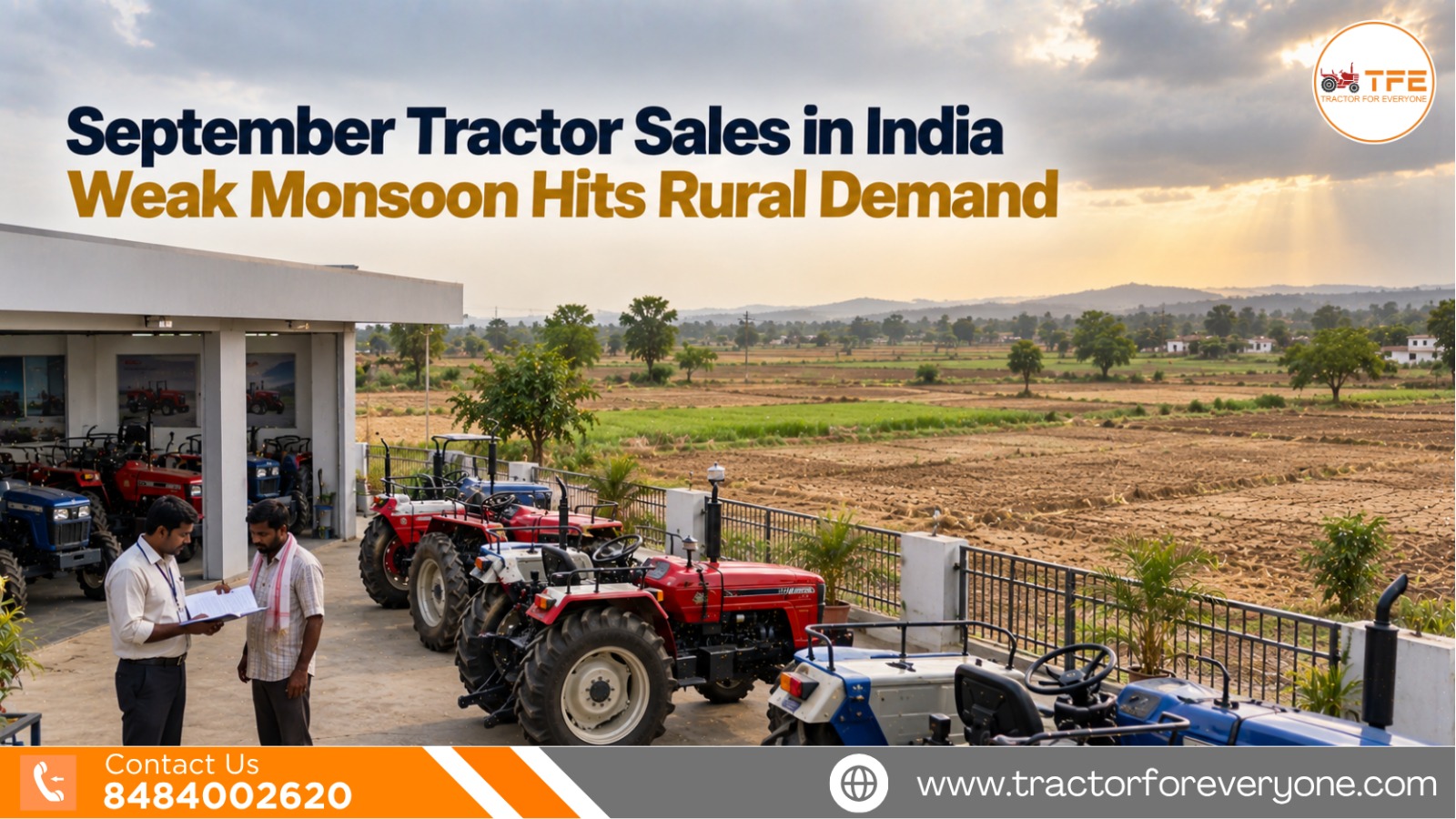
India's tractor market recorded mixed performance in September 2026, with retail sales declining from August while remaining higher than the same month last year. Uneven monsoon conditions, pressure on rural cash flows and a later festive calendar affected short-term demand, while differences between retail registrations and manufacturer dispatches created contrasting market signals.
According to the Federation of Automobile Dealers Associations (FADA), dealers retailed 76,906 tractors in September 2026, down 12.6% from 87,977 units in August but up approximately 13.7% from 67,612 units in September 2025. Separately, the Tractor and Mechanization Association (TMA) reported that domestic wholesale tractor sales fell 18% year-on-year to 119,667 units. These figures cover different sales channels and should be interpreted separately.
For farmers, dealers and tractor manufacturers, the September results highlight the relationship between rainfall, agricultural income, equipment affordability and the timing of purchases. They also raise a broader question: can precision farming, digital services and more accessible mechanisation help farmers make better equipment decisions when rural conditions are uncertain?
India's September tractor market showed a month-on-month retail slowdown alongside year-on-year retail growth. Wholesale sales, however, declined year-on-year, demonstrating why one sales figure alone cannot describe the industry's performance.
| Indicator | September 2026 result | What it indicates |
|---|---|---|
| Tractor retail sales reported by FADA | 76,906 units | Tractors retailed by dealers |
| Retail sales in August 2026 | 87,977 units | Higher monthly comparison base |
| Retail sales in September 2025 | 67,612 units | Lower year-earlier comparison base |
| Retail change month-on-month | -12.6% | Sales fell compared with August |
| Retail change year-on-year | Approximately +13.7% | Sales exceeded September 2025 |
| Domestic wholesale sales reported by TMA | 119,667 units | Manufacturer-level domestic sales |
| Wholesale change year-on-year | -18% | Lower dispatches than in September 2025 |
Retail sales generally reflect vehicles sold or registered through dealers, while wholesale sales refer to manufacturers' domestic dispatches or sales into the distribution channel. Timing differences, inventory levels and the definitions used by each data source can cause the two measures to move in different directions.
Uneven rainfall can influence tractor demand by affecting crop prospects, farm income and farmers' ability to finance equipment purchases. In 2026, India's June-to-September monsoon rainfall was reported at 12.6% below normal, creating concerns about agricultural output and rural purchasing power.
The monsoon is important to tractor demand because many farmers depend on rainfall for crop establishment and production. When rainfall is poorly distributed, farmers may face lower yields, additional irrigation costs or uncertainty about their next crop cycle.
Possible effects on tractor purchasing include:
Delayed buying decisions: Farmers may postpone a large equipment purchase until crop income becomes clearer.
Tighter cash flow: Spending on seed, fertiliser, irrigation and other inputs can leave less money available for machinery.
Greater caution over loans: Buyers may delay financing decisions if they are uncertain about repayment capacity.
Changes in farm operations: Farmers may prioritise irrigation, repairs or essential implements over purchasing another tractor.
Regional differences: Areas with better rainfall or stronger crop prospects may perform differently from districts experiencing dry spells or excess rainfall.
These are plausible economic channels, not proof that rainfall alone caused every change in tractor sales. Interest rates, crop prices, government support, replacement demand, inventory and the festive calendar also influence purchasing decisions.
The difference between monthly and annual comparisons reflects different reference periods. September retail sales were lower than August 2026 but higher than September 2025, so both results can be correct.
A month-on-month comparison captures short-term changes, including seasonal timing and the timing of registrations. A year-on-year comparison compares the same month across two years, but it can also be affected by an unusually high or low base.
The festive calendar is another factor. If major buying periods shift from September into October, some customers may delay registration or purchase until later in the season. FADA-linked reporting also highlighted the delayed festive season as a factor behind September's monthly decline.
The 2025 comparison requires caution because vehicle purchases and registrations were influenced by the timing of GST-related changes. A stronger year-on-year figure therefore does not automatically mean demand accelerated consistently through September 2026.
For a clearer picture, farmers, dealers and industry analysts should track monthly and annual retail growth, wholesale dispatches, regional performance and subsequent-month data together.
The September figures suggest that manufacturers need to manage both short-term demand uncertainty and longer-term competition. A weaker monthly retail result does not necessarily indicate a sustained market contraction, particularly when the annual comparison remains positive.
Manufacturer-level sales can vary because of product mix, regional presence, dealer inventory, financing arrangements and customer demand across tractor horsepower categories. Wholesale dispatches can also change when manufacturers or dealers adjust stock levels.
For tractor companies, the market conditions create several priorities:
Align production and dealer inventory with realistic demand forecasts.
Monitor rainfall, crop conditions and regional agricultural activity.
Offer transparent finance options without encouraging unsuitable borrowing.
Strengthen after-sales support and access to spare parts.
Communicate operating costs, fuel efficiency and implement compatibility clearly.
Use customer feedback to understand demand for compact, utility and higher-horsepower tractors.
Farmers should not interpret a manufacturer's sales decline as proof that its tractors are inferior, or a sales increase as proof that a model is the best choice. Tractor selection should depend on farm size, soil conditions, implements, workload, service access and total ownership cost.
Technology may influence how farmers evaluate and use tractors, although it should not be presented as the direct cause of September's sales movement without supporting evidence. Precision agriculture, digital farm services and equipment-sharing models are relevant trends because they can change how farmers manage costs and access machinery.
Precision farming uses information such as field conditions, crop requirements and machine performance to support more informed decisions. Depending on the system, tools can include GPS guidance, digital field records, sensors and equipment-monitoring features.
These technologies may help reduce unnecessary passes, improve field-operation planning or monitor machine use. Benefits depend on the farm, equipment, connectivity, operator skills and cost of adoption.
Farmers increasingly have opportunities to compare tractor specifications and features online before visiting a dealer. Digital research can help buyers evaluate horsepower, PTO performance, hydraulic lift capacity, transmission, service availability and compatibility with implements.
Tractor For Everyone can support this decision process by presenting clear model information and comparison resources. Product claims and specifications should be verified against manufacturer information rather than inferred from a tractor's price or horsepower alone.
Not every farmer needs to own every machine. Custom hiring centres and local rental services can help farmers access tractors and implements for seasonal operations without paying the full purchase cost.
For small and marginal farmers, this model can be useful when machinery is needed for only a limited number of days. Actual savings depend on rental rates, availability during peak periods, transport charges and the number of operations required.
Online finance information can help buyers compare down payments, instalments, repayment periods and total borrowing costs. However, farmers should assess expected farm income, interest charges, insurance, maintenance, fuel and repair costs before committing to a loan.
Digital tools are most useful when they improve transparency and decision-making. They cannot eliminate the risks caused by poor rainfall, weak crop prices or unpredictable farm income.
Farmers considering a tractor purchase should base the decision on farm requirements and repayment capacity rather than short-term sales headlines. The September market figures describe industry activity; they do not determine whether buying a tractor is right for an individual farm.
Before purchasing, farmers should:
Estimate annual utilisation: List the field operations, transport tasks and approximate hours the tractor will perform.
Match horsepower to the workload: Check the requirements of the implements, soil and terrain.
Calculate total ownership cost: Include the purchase price, financing, fuel, insurance, maintenance, tyres and repairs.
Compare new and used tractors: Assess condition, service history, parts availability, warranty and resale value.
Review financing carefully: Compare the effective cost of borrowing and make sure repayments fit realistic income estimates.
Consider hiring for seasonal work: Renting machinery may be practical if annual utilisation is low.
Check dealer support: Confirm service access and spare-parts availability in the local area.
Farmers should also review current government schemes only through official sources and confirm eligibility, application deadlines and approved equipment before relying on a subsidy in their budget.
The near-term tractor market will depend on several variables rather than a single sales report. Rainfall distribution, crop output, farm-gate prices, rural liquidity, financing conditions, inventory and the timing of festive purchases can all influence demand.
The September 2026 figures show a mixed picture: retail sales increased year-on-year but declined month-on-month, while domestic wholesale sales were lower than a year earlier. This suggests that the market should be assessed using multiple indicators and subsequent monthly results.
A sustained improvement in rural cash flow could support purchases, while continued agricultural uncertainty may encourage some buyers to delay investment. Manufacturers and dealers will need to watch regional demand and stock levels rather than assume that the annual retail increase guarantees continued growth.
Technology may support more efficient equipment use and better purchase decisions, but adoption will depend on affordability, practical value, support services and farmers' specific needs.
September 2026 tractor sales in India reflected mixed market conditions: FADA-reported retail sales reached 76,906 units, down 12.6% from August but up approximately 13.7% from September 2025, while TMA-reported domestic wholesale sales declined 18% year-on-year to 119,667 units.
The below-normal monsoon and delayed festive calendar were important factors cited in market reporting, but they should be considered alongside the base effect, dealer inventory and agricultural purchasing cycles. For farmers, the practical lesson is to assess tractor purchases using farm needs, affordability and total operating costs—not industry headlines alone.
Tractor For Everyone provides tractor information and comparison resources to help farmers research available options. Buyers should confirm technical specifications, prices, financing terms and service details with the manufacturer or authorised dealer before making a purchase.
Popular Blogs View All



Popular Video View All


Best Used Car, Services, Auto Parts, Rent Car Available for Buy and Sell Near By Go Ahead
