
 Sell Your Tractor

Best Used Car, Services, Auto Parts, Rent Car Available for Buy and Sell Near By Go Ahead
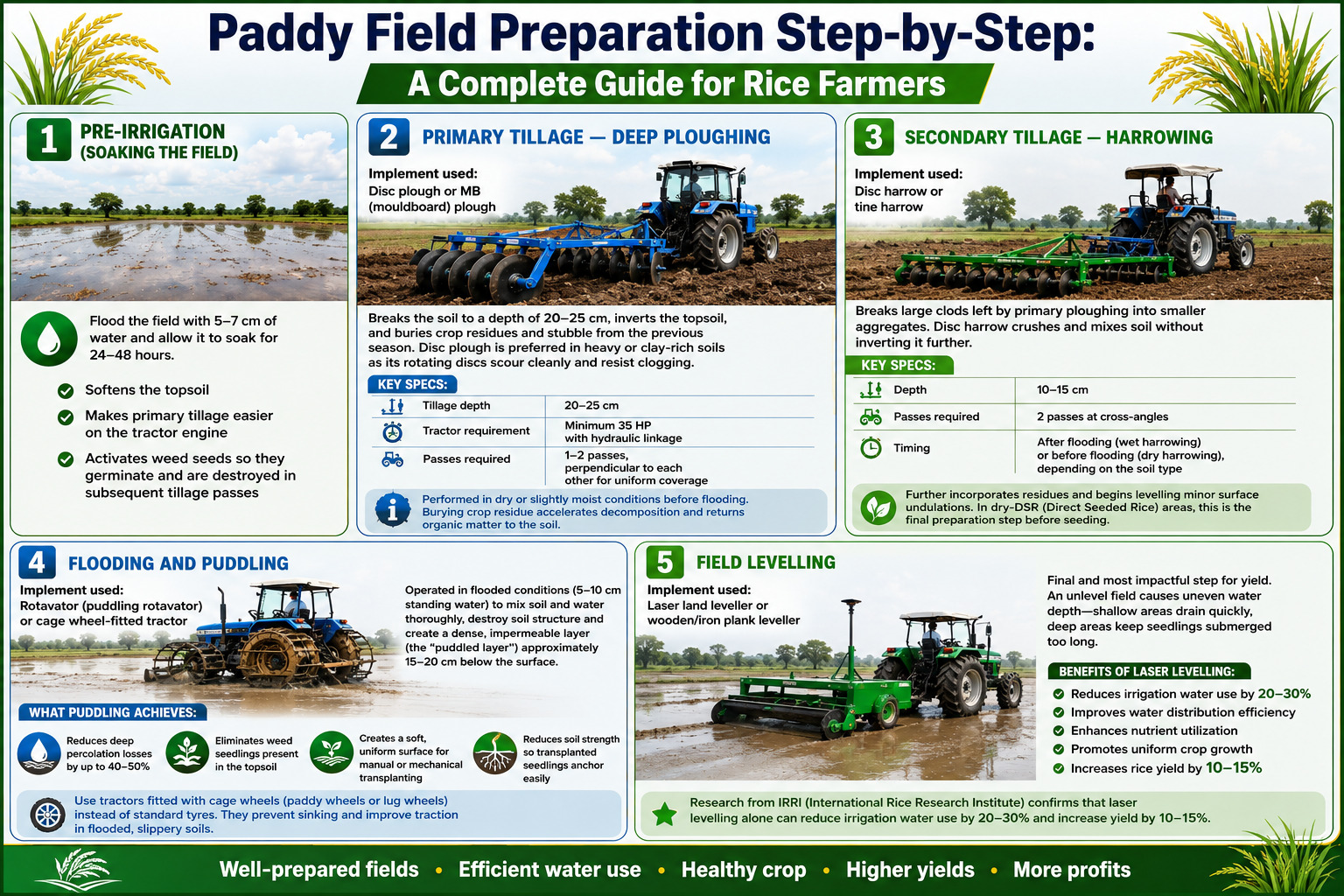
Paddy field preparation is the process of converting a dry or fallow field into a flooded, levelled, and puddled seedbed ready for rice transplanting or direct seeding. It is one of the most labour-intensive and yield-critical stages in the rice cultivation cycle.
Done correctly, field preparation controls weeds before planting, improves water retention, breaks up soil compaction, and creates the uniform surface that young rice seedlings need to establish evenly. Done poorly, it wastes irrigation water, promotes weed competition, and reduces crop stand uniformity — all of which directly reduce yield potential.
A paddy field preparation tractor is the primary power source for every mechanised tillage and levelling operation in rice cultivation. Tractors replace traditional animal draught power, reduce land preparation time from days to hours, and allow precise depth control that manual or animal-based systems cannot achieve.
For paddy fields specifically, tractors must operate in wet, flooded, and muddy conditions. This makes tyre type, engine torque, and the compatibility of rice farming implements critical selection factors. A tractor rated between 35 HP and 55 HP is suited to small and medium paddy holdings (1–10 acres), while larger farms typically use 60 HP and above.
Step 1: Pre-Irrigation (Soaking the Field)
Before any tillage begins, flood the field with 5–7 cm of water and allow it to soak for 24–48 hours. This softens the topsoil, makes primary tillage easier on the tractor engine, and activates weed seeds so they germinate and are destroyed in subsequent tillage passes.
Step 2: Primary Tillage — Deep Ploughing
Implement used: Disc plough or MB (mouldboard) plough
Primary tillage breaks the soil to a depth of 20–25 cm, inverts the topsoil, and buries crop residues and stubble from the previous season. For rice fields, a disc plough is preferred over an MB plough in heavy or clay-rich soils because its rotating discs scour cleanly and resist clogging.
Key specs:
This operation is performed in dry or slightly moist conditions before the field is flooded. Burying previous crop residue during primary tillage accelerates decomposition and returns organic matter to the soil.
Step 3: Secondary Tillage — Harrowing
Implement used: Disc harrow or tine harrow
Secondary tillage breaks the large clods left by primary ploughing into smaller aggregates. A disc harrow is the most common rice farming implement used at this stage — its independently mounted discs crush and mix soil without inverting it further.
Key specs:
Harrowing also further incorporates residues and begins levelling minor surface undulations. In areas using a dry-DSR (Direct Seeded Rice) method, secondary tillage is the final preparation step before seeding.
Step 4: Flooding and Puddling
Implement used: Rotavator (puddling rotavator) or cage wheel-fitted tractor
Puddling is the defining characteristic of paddy field preparation and is not used in any other crop system. It involves operating a rotavator or puddling rotavator in flooded conditions (5–10 cm standing water) to thoroughly mix soil and water, destroying soil structure and creating a dense, impermeable layer (the "puddled layer") approximately 15–20 cm below the surface.
What puddling achieves:
Tractors used for puddling should be fitted with cage wheels (also called paddy wheels or lug wheels) in place of standard rubber tyres. Cage wheels prevent the tractor from sinking and improve traction in flooded, slippery soils.
Step 5: Field Levelling
Implement used: Laser land leveller or wooden/iron plank leveller
Field levelling is the final preparation step and arguably the most impactful for yield. An unlevel paddy field results in uneven flood depth — shallow areas drain too quickly, deep areas keep seedlings submerged for too long. Research from IRRI (International Rice Research Institute) indicates that laser levelling alone can reduce irrigation water use by 20–30% and increase yield by 10–15%.
Two levelling options:
| Method | Accuracy | Cost | Best For |
|---|---|---|---|
| Laser land leveller | ±2 cm | High capital, low operating | Large farms, 3 acres+ |
| Plank/float leveller | ±5–8 cm | Low cost | Small farms, basic levelling |
For farmers using TractorForEveryone's comparison tools, laser levellers can be attached to tractors from 45 HP upwards and are available through agricultural equipment dealers as both purchase and hire options.
Step 6: Basal Fertiliser Incorporation
Implement used: Fertiliser broadcaster or rotavator (second pass)
Immediately after levelling and before transplanting, basal fertiliser (typically DAP or SSP for phosphorus, and MOP for potassium) is broadcast across the field and incorporated with a light rotavator pass or by simply allowing the standing water to distribute it. This step ensures nutrients are available at the root zone from the first day of crop establishment.
| Implement | Stage | Function |
|---|---|---|
| Disc plough | Primary tillage | Deep soil inversion, residue burial |
| Disc harrow | Secondary tillage | Clod breaking, soil mixing |
| Puddling rotavator | Puddling | Wet soil mixing, weed destruction |
| Cage wheels | Puddling | Tractor traction in flooded fields |
| Laser land leveller | Levelling | Precision surface uniformity |
| Fertiliser broadcaster | Basal dressing | Even nutrient distribution |
| Transplanter | Post-preparation | Mechanical rice seedling placement |
The right paddy field preparation tractor depends on farm size, soil type, and which rice farming implements you plan to run. Below are the three most common tractor categories used in Indian paddy cultivation:
Mini tractors (18–25 HP): Suitable for very small paddy plots under 2 acres. Limited to light harrowing and plank levelling. Not suitable for puddling with heavy rotavators.
Medium tractors (35–50 HP): The most widely used category for paddy field preparation across India. Compatible with disc ploughs, disc harrows, puddling rotavators, and basic laser levellers. Brands such as Mahindra 475 DI, Swaraj 744 FE, and Sonalika DI 42 fall in this category.
High-power tractors (55 HP+): Preferred for large paddy farms and commercial cultivation. Support heavier implements and faster field turnaround.
The correct sequence is: pre-irrigation → primary tillage (ploughing) → secondary tillage (harrowing) → flooding and puddling → field levelling → basal fertiliser incorporation. This order ensures each step builds on the previous one — soft soil enables effective puddling, and puddling must be complete before levelling for an accurate result.
A tractor between 35 HP and 50 HP is best suited for paddy field preparation on small to medium farms (1–10 acres). This range provides sufficient torque for disc ploughing, puddling rotavators, and laser levellers without excessive fuel consumption or soil compaction from over-heavy machinery.
Puddling in rice farming is the process of operating a rotavator in flooded soil to destroy soil structure and create an impermeable hardpan layer. It is done to reduce water percolation losses, eliminate weed seedlings, and produce a soft uniform surface for transplanting rice seedlings.
Yes — farmers using dry Direct Seeded Rice (DSR) methods skip puddling and prepare a firm, dry seedbed instead. However, traditional transplanted rice and wet-DSR still require puddling to achieve the anaerobic soil conditions that suppress weeds and reduce irrigation losses effectively.
Cage wheels (also called paddy wheels or lug wheels) are metal wheel attachments fitted to a tractor's rear axle in place of rubber tyres when operating in flooded paddy fields. They provide traction in slippery, waterlogged soil and prevent the tractor from sinking or spinning, making puddling and levelling operations safe and efficient.
Popular Blogs View All

Popular Video View All
Best Used Car, Services, Auto Parts, Rent Car Available for Buy and Sell Near By Go Ahead
