
 Sell Your Tractor

Best Used Car, Services, Auto Parts, Rent Car Available for Buy and Sell Near By Go Ahead
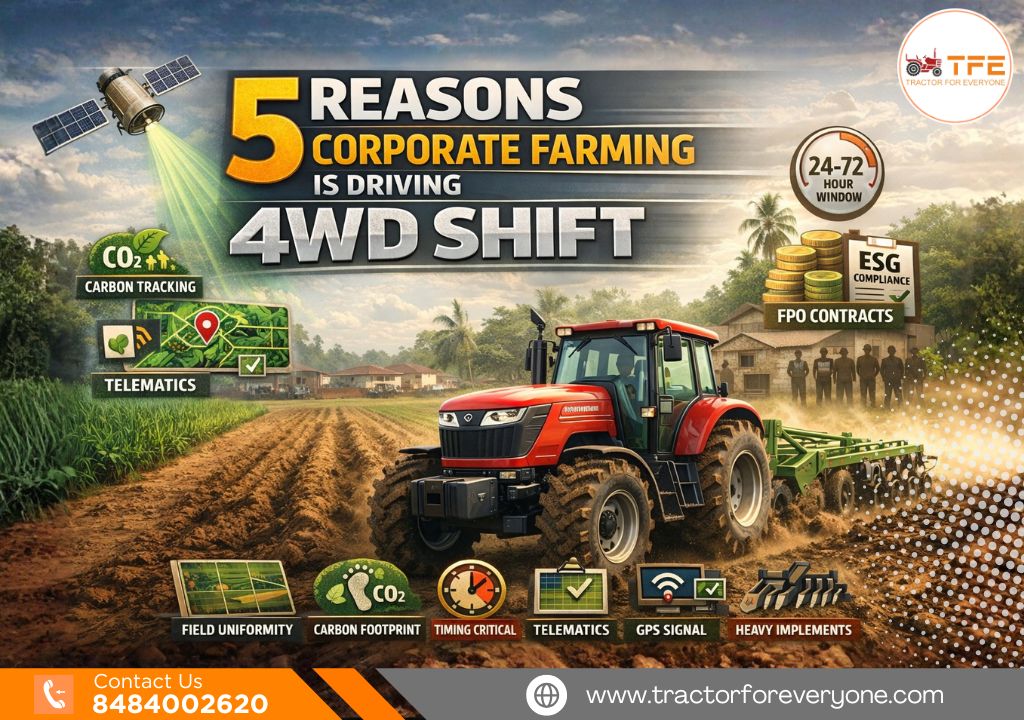
4WD tractor demand in India is rising sharply in 2026 because corporate farming contracts now mandate satellite-verified field uniformity, carbon footprint tracking, and tractor telematics as contractual compliance requirements — not optional features. In the February–March sowing window, 4WD tractors give FPOs (Farmer Producer Organisations) the traction, depth control and digital traceability needed to meet export-crop deadlines without risking contract penalties.
Corporate farming contracts in India in 2026 now mandate satellite-verified field uniformity, digital fuel logs and carbon tracking as contractual conditions — requirements that 2WD tractors routinely fail to meet. This compliance shift, not a desire for extra power, is the primary driver of 4WD tractor demand in India's export-linked FPO clusters.
|
Contract KPI |
Pre-2020 Focus |
2026 Corporate Requirement |
|
Primary metric |
Yield per acre |
Uniform seedbed + yield |
|
Tillage verification |
None |
Satellite-verified depth accuracy |
|
Carbon tracking |
Not required |
Emissions per kg of produce |
|
Machine data |
Not required |
Digital fuel logs + hour tracking |
|
Timing tolerance |
Flexible |
24-72 hour sowing window |
|
Audit mechanism |
Visual inspection |
Telematics log + GPS imagery |
4WD tractors outperform 2WD tractors in export-contract farming because they deliver less than 5% wheel slip under heavy draft loads, compared to 15%+ slip in 2WD models — directly reducing fuel waste, soil compaction and tillage depth variability. In 2026, this performance gap has made traction a compliance factor, not just an engineering specification.
|
Performance Factor |
2WD Tractor |
4WD Tractor |
|
Wheel slip under heavy draft load |
15%+ (field-reported) |
Less than 5% |
|
Fuel loss due to slippage |
Up to 20% per hour |
Significantly reduced |
|
Tillage depth consistency |
Variable, esp. in wet soil |
Stable depth control |
|
Soil compaction |
Higher compaction patches |
Balanced weight distribution |
|
Completion speed (heavy draft) |
Standard |
Up to 30% faster per acre |
|
Telematics integration |
Often absent in older fleets |
Standard in 2026 models |
Key Implements That Require 4WD Compatibility in 2026 Contracts:
The February-March 2026 sowing window has tightened to 24-72 hours in several export-linked belts due to erratic western disturbances and damp soil conditions — and missing this window now triggers financial penalties under corporate farming contracts. A 48-hour delay caused by 2WD wheel slip in wet soil can breach just-in-time supply commitments and eliminate contract bonuses.
Consequences of a 48-Hour Sowing Delay Under Corporate Contract:
Some Indian corporate farming contracts in 2026 now link 'green premium' payouts to per-acre carbon emissions, making reduced wheel slip — a direct outcome of 4WD traction — a measurable ESG metric. Modern 4WD tractors equipped with GPS and telematics satisfy digital audit requirements for fuel logs, working depth records and operational hours that most older 2WD fleets cannot provide.
|
Contract Requirement |
Corporate Specification |
4WD Capability |
2WD Gap |
|
Traceability audit |
Digital fuel and depth logs |
GPS + telematics standard |
Often not available |
|
Soil health score |
Minimal compaction |
Balanced 4-wheel weight |
Higher compaction risk |
|
Sowing punctuality |
24-72 hour window |
Superior wet-soil traction |
Wheel slip causes delays |
|
Carbon footprint |
Emissions per kg produce |
Less than 5% slip = lower fuel burn |
20% fuel loss from slip |
|
Seedbed uniformity |
Satellite-verified rows |
Stable depth control |
Uneven depth in heavy soil |
Digital Compliance Features Now Standard on 4WD Models (2026):
FPOs (Farmer Producer Organisations) are the primary vehicle through which smallholder farmers are accessing 4WD tractors in 2026, using pooled fleet leasing models that share compliance-ready machinery across members. Banks and NBFCs have increased agri-machinery financing in Q1 2026, and certified 4WD rental hubs are expanding ahead of peak season across major contract farming belts.
Three Access Routes for Smallholders:
OEMs (Original Equipment Manufacturers) are adjusting product lines in 2026 to offer compliance-ready 4WD variants with telematics pre-installed, targeting FPO fleet procurement contracts directly.
4WD Fleets Reshape Contract Farming 2026
March 2026 clearly marks the rise of certified 4WD fleet leasing across major contract farming belts. What began as a seasonal shift during the Feb–March sowing window has now become a structural change in how Corporate farming contracts India operate. High-value crop production compliance is no longer limited to yield targets; it now covers uniform seedbeds, punctual sowing, and carbon footprint tracking in agriculture contracts.
FPOs are emerging as key mechanization aggregators. Many are pooling resources to lease 4WD tractors for contract farming so members can meet strict Tractor compliance requirements for export crops. In this environment, the 4WD tractor demand in India 2026 is being driven not by power preference, but by eligibility rules written into corporate agreements.
Today, a 4WD tractor has become:
The 4WD vs 2WD tractor for heavy implements debate has shifted decisively toward traction, telematics, and Super Seeder tractor compatibility 4WD. Farmers without access to certified fleets risk losing entry into high-value crop contracts India, especially where telematics and traceability audits are mandatory.
Looking ahead, industry trends suggest:
The direction is clear and data-backed. In 2026, 4WD adoption is not optional - it is the gateway to staying competitive in corporate crop contracts.
Popular Blogs View All



Popular Video View All
Best Used Car, Services, Auto Parts, Rent Car Available for Buy and Sell Near By Go Ahead
