
 Sell Your Tractor

Best Used Car, Services, Auto Parts, Rent Car Available for Buy and Sell Near By Go Ahead
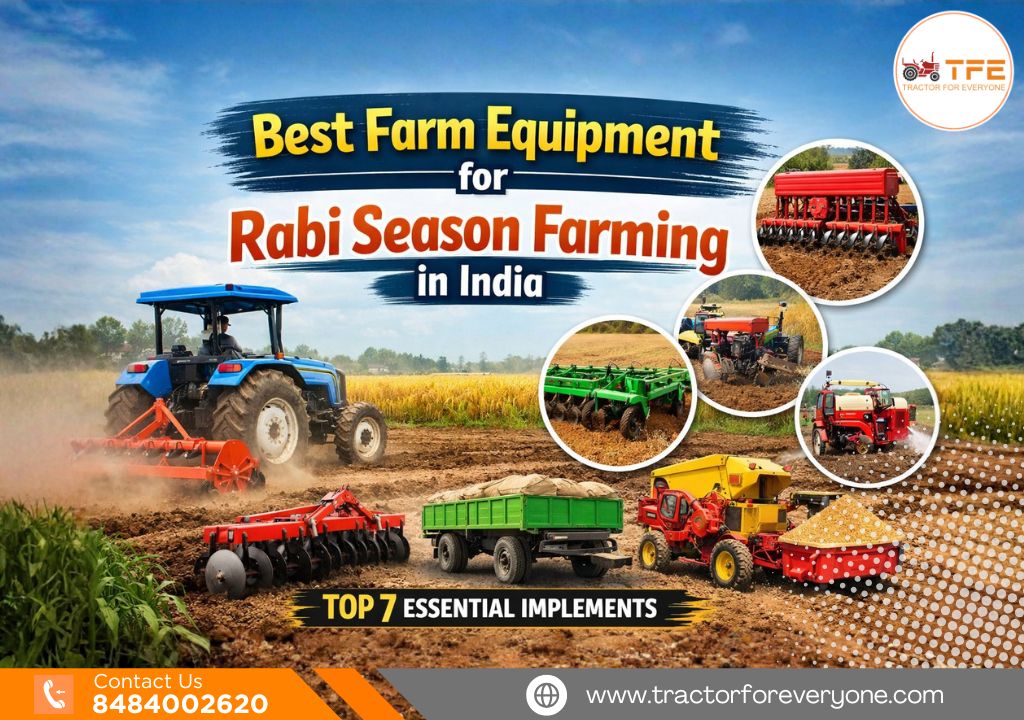
Rabi season doesn't wait. From the moment Kharif is off the field, there's a narrow window to prepare land, sow on time, and keep the crop healthy through winter. Miss that window — even by a few days — and germination suffers, yields drop, and the entire season's effort feels wasted.
The good news? The right tractor setup can make that window feel much wider. This guide walks you through the six key implements that matter most during Rabi, why each one earns its place on the farm, and how to build a practical, cost-effective machinery setup whether you're farming 5 acres or 50.
Wheat, mustard, chickpea, and lentils all share one thing — they're unforgiving about soil conditions and sowing timing. Unlike Kharif, where monsoon moisture does much of the heavy lifting, Rabi crops depend on proper tillage, precise seed placement, and timely protection during cold, foggy months.
That's why farmers who rely on manual tools or outdated equipment consistently struggle with uneven germination, pest pressure, and yield gaps. A tractor-based setup, built around the right implements, changes all of that.
1. Rotavator — Your First Move After Kharif
If there's one implement that sets the tone for the whole Rabi season, it's the rotavator. Attached to your tractor's PTO, it breaks down hard, compacted soil left after Kharif harvest, chops and mixes crop residue, and creates a fine, even seedbed — often in just one or two passes.
What makes it especially valuable is speed. Post-Kharif, soil moisture is at the right level for a short window. The rotavator helps you act fast, covering large areas before that moisture disappears. It also uses significantly less diesel compared to repeated conventional tillage passes.
For wheat and mustard farmers in particular, starting with a well-prepared seedbed after rotavation makes everything downstream — sowing, germination, irrigation — work better.
2. Plough — When the Soil Needs a Deeper Reset
Not every field needs deep tillage every year, but when it does, nothing replaces a good plough. An MB or disc plough paired with a strong tractor turns over deeper soil layers, buries weed seeds and old crop roots, and refreshes the nutrient profile before sowing.
It's particularly useful in fields with heavy clay soils or those that have been continuously shallow-tilled for several seasons. Roots of wheat and mustard grow deeper and stronger when the plough has broken through the hard layer underneath the topsoil.
A word of advice: match your plough type to your soil. Disc ploughs handle harder, stony soils better. MB ploughs are more effective in medium-textured loam where you want a clean furrow.
3. Cultivator — The Finishing Touch Before Sowing
Think of the cultivator as the step that brings everything together. After ploughing or rotavation, the field still needs final levelling, light loosening, and moisture locking before a seed drill can do its job well.
A tractor-mounted cultivator does this efficiently — breaking up any remaining clods, uprooting small weed seedlings, and creating a consistently loose, aerated surface that seed drills can penetrate at uniform depth.
Many experienced farmers run a cultivator pass the evening before sowing. It seals the day's work, keeps moisture in, and ensures the seed drill moves smoothly the next morning without depth variation.
4. Seed Drill — Where Precision Pays Off
This is the implement that directly impacts your harvest. A tractor-mounted seed drill places seeds at a consistent depth, maintains correct spacing between plants, and deposits fertilizer right where roots will reach it — all at the same time.
The difference in germination uniformity between broadcast sowing and seed drill sowing is visible within two weeks. Plants emerge in straight rows, at even intervals, with far less seed wastage. On a 10-acre plot, the seed and fertilizer savings alone can offset a significant part of the equipment cost over a single season.
For wheat sowing specifically, seed drill timing and depth control are critical. A few millimetres of variation in seed depth across a field can mean patchy stands and uneven maturity at harvest.
Why farmers who use seed drills rarely go back to manual sowing:
5. Tractor-Mounted Sprayer — Protecting Your Crop Through Winter
Foggy winters create ideal conditions for fungal diseases, aphids, and other pests that target wheat and mustard. Timely spraying isn't optional — it's what separates a 40-quintal crop from a 30-quintal one.
A tractor-mounted sprayer covers ground far faster than manual knapsack spraying, delivers more uniform chemical distribution, and reduces operator exposure to pesticides. On larger fields, it can complete in two hours what would take a team of workers a full day.
It also enables liquid fertigation — applying water-soluble nutrients directly through the spray system during dry spells — giving farmers an additional tool for crop nutrition management.
6. Tractor Trailer — The Underrated Workhorse
It rarely gets mentioned in machinery guides, but ask any experienced farmer and they'll tell you: moving inputs and outputs quickly makes or breaks the operational rhythm of the season.
A tractor trailer carries fertilizer bags to the field at sowing time, grain to the thresher after harvest, and everything in between. On farms without a dedicated trailer, labour time spent on manual carrying can be surprisingly large — and surprisingly expensive.
Paired with proper field levelling (ideally done using a laser leveller before Rabi begins), a trailer also supports efficient irrigation management by ensuring water reaches the field uniformly.
7. Tractor Harvest Support for Timely Yield
Tractors also power harvesting or threshing equipment that speeds up crop collection. Timely harvesting protects grain quality and avoids weather damage, which is crucial for winter crops.
Many setups include tractor-driven harvest tools or the super seeder tractor for wheat sowing earlier in the cycle to ensure proper timing from sowing to harvest. These systems are part of tractor equipment for rabi crops that improve productivity and form the backbone of rabi season farming equipment in India.
| Implement | Primary Role | Rabi Season Benefit |
|---|---|---|
| Rotavator | Breaks and mixes soil | Fast, fuel-efficient seedbed prep |
| Plough | Deep soil turning | Better root development |
| Cultivator | Surface finishing | Moisture retention + weed control |
| Seed Drill | Precision sowing | Uniform germination, less seed waste |
| Tractor Sprayer | Crop protection | Controls winter pest and disease |
| Tractor Trailer | Farm transport | Saves time and labour costs |
You don't need every implement at once. Most farmers on small to medium holdings (5–20 acres) get their best return from three core pieces: a rotavator, a seed drill, and a sprayer. These three together cover the most critical operations — land prep, sowing, and crop protection — and have the clearest yield impact.
If you're farming larger areas or running a custom hiring service, adding a plough and cultivator to the mix gives you flexibility across soil types and seasons.
A few things worth checking before you buy any implement:
For most Rabi farming needs — rotavation, seed drilling, spraying, and transport — a 35 to 50 HP tractor covers the full range comfortably. Heavier operations like deep ploughing in black cotton soil may benefit from 50–60 HP.
What matters as much as HP is torque delivery and PTO stability under load. A tractor that holds steady PTO speed during rotavation gives you more consistent soil preparation than a higher-HP machine that bogs down under resistance.
Every farm has a different situation — soil type, crop mix, land size, budget, and local service availability all matter. If you'd like to talk through which implements make sense for your specific setup, our team is happy to help.
Call us directly: (+91) 8484002620
Email: info @ tractorforeveryone.com
You can also explore:
For high-wear items like rotavators and seed drills, new equipment is usually worth it — worn blades or blocked coulters directly affect field quality. For trailers or simple cultivators, a good second-hand unit often makes financial sense.
Yes — most modern 35–55 HP tractors are designed to handle the full range of Rabi implements. The key is ensuring your three-point linkage and PTO specifications are compatible with each attachment.
Savings vary by crop and field size, but most farmers report 10–15% lower seed use and a noticeable improvement in germination uniformity. On wheat, that often translates to a meaningful yield increase by harvest.
Ideally in September or early October — after Kharif harvest and before the soil dries out completely. Levelling in dry, hard soil is difficult and less effective.
Most leading NBFC and bank tie-ups cover implements along with tractor loans. Our Finance page has current options with straightforward eligibility steps.
Popular Blogs View All


Popular Video View All
Best Used Car, Services, Auto Parts, Rent Car Available for Buy and Sell Near By Go Ahead
