
 Sell Your Tractor

Best Used Car, Services, Auto Parts, Rent Car Available for Buy and Sell Near By Go Ahead
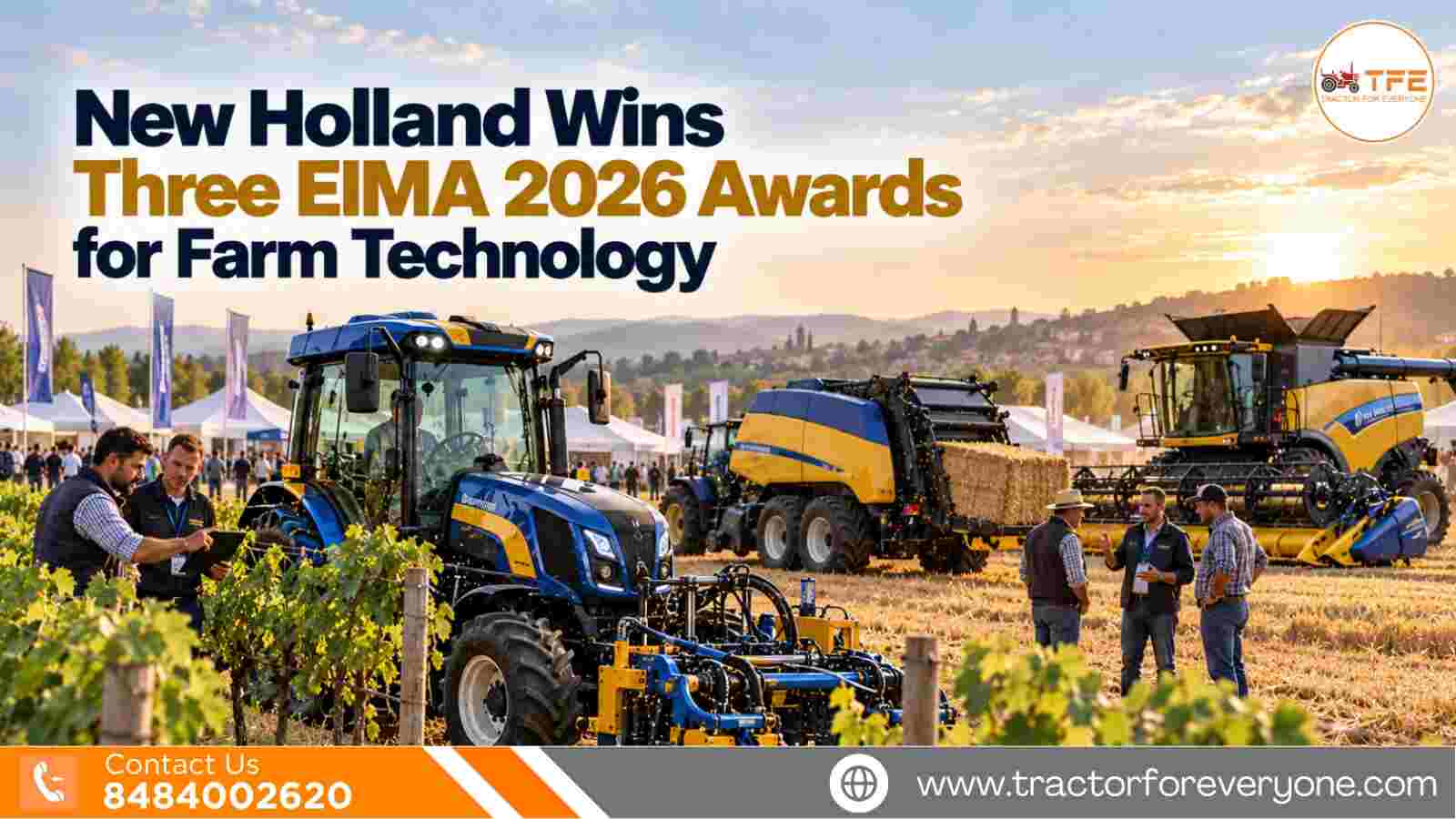
New Holland has received three awards in the EIMA Technical Innovation 2026 competition for technologies spanning specialty tractors, large square balers and combine harvesters. The recognised developments focus on electrified tractor-implement operation, intelligent baler performance and automatic traction management, highlighting how agricultural machinery is evolving towards more connected and data-driven field operations.
The awards were announced on 29 September 2026 by New Holland, the agricultural machinery brand within CNH. Two technologies received EIMA Technical Innovation Awards, while Combine Smart Traction Control received an EIMA Technical Evolution Award. The technologies are scheduled to be presented at EIMA International 2026 in Bologna, Italy, from 10 to 14 November.
New Holland's three recognitions cover three different agricultural operations: specialty-tractor work in orchards and vineyards, high-capacity baling, and combine harvesting in difficult field conditions. Together, they illustrate how manufacturers are using electrification, real-time sensing and automated control to address practical machinery challenges.
The recognised technologies are:
| Technology | Machinery application | Main development |
|---|---|---|
| T4F eSource Mild Hybrid System | Specialty tractor and implements | Hybrid power assistance and coordinated electric implement operation |
| BigBaler Enhanced Baler Productivity | Large square baler | Sensing and intelligent driveline control to manage changing crop loads |
| Combine Smart Traction Control | Combine harvester | Automatic distribution of traction between front and rear axles |
The distinction between the award categories is important. New Holland reports that the T4F eSource system and BigBaler technology received Technical Innovation Awards, while Combine Smart Traction Control was recognised for Technical Evolution.
The New Holland T4F eSource Mild Hybrid System is a prototype specialty-tractor concept designed for applications such as vineyards and orchards. It combines mild-hybrid powertrain assistance with electric power delivery and coordinated control of front- and rear-mounted implements.
Specialty tractors operate in environments where space, precision, noise and implement coordination can be particularly important. Vineyard and orchard work may involve several tasks during a single pass, making the way a tractor distributes power to its wheels and implements a significant engineering consideration.
The system uses New Holland's Intelligent Power Flow Management System to coordinate power and information between the tractor and compatible implements. Instead of treating each implement as an entirely separate load, the system is designed to manage the overall operation as a connected tractor-implement combination.
The concept combines three main elements:
Mild-hybrid powertrain assistance: Supports the tractor's powertrain using hybrid technology.
Electric implement operation: Supplies electrical power to compatible implements.
Coordinated energy management: Uses system information to manage the distribution of available power between traction and implements.
New Holland plans to demonstrate the concept with a rear-mounted Nobili e-BV 16 mulcher and a front-mounted Tecnovict 111E leaf stripper. This combination illustrates how two different tasks could be coordinated in one field pass while preserving each implement's operating settings.
A coordinated multi-implement system could reduce the need for separate field passes when the selected tasks and field conditions allow them to be combined. Fewer passes may help reduce operating time and soil disturbance, although the actual outcome depends on the crop, terrain, work rate and equipment setup.
New Holland reports potential fuel savings of up to 52% for the demonstrated tractor-and-implement combination. This is a manufacturer-reported figure for the described operating concept, not a guarantee of savings for every tractor, implement, orchard or vineyard. Farmers should wait for comparable independent testing and commercial specifications before using this number to estimate operating costs.
The broader technology trend is the movement towards electrified implements and intelligent power management—not simply replacing a conventional engine with a battery. The practical value depends on system reliability, charging or electrical architecture, service support and compatibility with the tasks farmers need to perform.
New Holland's BigBaler Enhanced Baler Productivity technology is designed to help large square balers handle changing crop loads more smoothly. It combines a hydraulically controlled slip-clutch driveline with real-time sensing and intelligent controls to manage torque and crop flow.
Large square balers process substantial volumes of crop material. Sudden changes in windrow size or crop density can create short-term load peaks, potentially interrupting feeding or triggering overload protection. Managing those peaks is important for maintaining productive operation.
A conventional overload mechanism may stop crop flow when the driveline reaches a protection threshold. New Holland's approach is designed to allow controlled clutch slip during certain load peaks, helping absorb torque variations while the system manages the flow of crop material.
The reported technology includes:
Real-time monitoring of torque and crop flow.
Intelligent controls that respond to changing operating conditions.
Auto-tuning and self-calibration functions.
Predictive driveline protection that considers changing conditions and component behaviour.
Tractor-baler automation that adjusts travel speed to support productive operation.
The objective is to reduce avoidable interruptions and help the baler maintain smoother operation when crop conditions vary. New Holland also identifies improved operator experience and greater throughput as intended benefits.
Baling productivity depends on more than the machine's nominal capacity. Windrow consistency, crop moisture, field layout, tractor performance, operator decisions and downtime all affect the amount of crop processed during a working day.
Intelligent load management could help a baler respond to changing crop conditions without relying entirely on manual adjustments. However, the actual benefit will vary with crop type, windrow conditions, machine configuration and operating practice. Buyers should evaluate measured field performance, service requirements and the technology's compatibility with their existing tractor and baler setup.
The larger industry trend is the shift from fixed mechanical protection towards sensing-assisted machinery that can respond to conditions while work is underway.
New Holland's Combine Smart Traction Control is a prototype system designed to adjust traction distribution between the front and rear axles of a combine harvester. It uses real-time machine and operating information to respond to changes in terrain, slope and load.
Combine harvesters can encounter difficult conditions in wet, muddy or sloping fields. Wheel slip can waste energy, reduce forward progress and increase the risk of a machine becoming stuck. Traction management is therefore an important consideration for harvesting productivity and operator confidence.
According to New Holland, the system uses multiple inputs, including slope inclination, grain-tank and fuel levels, and gear selection, to help determine the appropriate traction balance. The hydrostatic system then adjusts torque distribution between the front and rear axles in response to operating conditions.
The intended benefits include:
Reducing unnecessary wheel slip.
Improving traction in challenging field conditions.
Helping limit avoidable fuel use associated with poor traction.
Reducing the risk of the combine becoming stuck.
Supporting operator comfort and productivity.
These are intended outcomes of the prototype technology, not guaranteed results for every harvesting condition. Actual performance depends on soil moisture, terrain, machine configuration, crop load and operating technique.
Reducing unnecessary wheel slip may help limit some forms of soil disturbance. However, soil compaction is also affected by axle loads, tyre pressure, the number of machine passes, soil moisture and traffic patterns.
Smart traction control should therefore be understood as one potential part of a wider soil-management strategy, rather than a complete solution to soil compaction. Farmers and contractors should consider machine weight, tyre setup, field conditions and traffic planning alongside traction technology.
The three award-winning developments address different tasks, but they share a common direction: using machine data and automated control to make equipment respond more effectively to changing field conditions.
This trend is relevant to precision agriculture and smart farming, where sensors, software, connectivity and control systems can support more targeted machinery operation.
| Technology trend | Example from New Holland | Potential operational value |
|---|---|---|
| Electrification | T4F eSource Mild Hybrid System | Coordinated power delivery to tractor and implements |
| Intelligent machine control | BigBaler Enhanced Baler Productivity | More responsive management of torque and crop flow |
| Automated traction management | Combine Smart Traction Control | Better adaptation to terrain and changing grip |
| Connected tractor-implement operation | T4F eSource concept | Coordination of multiple tasks in a field pass |
| Data-informed operation | Baler and combine systems | Adjustments based on operating conditions rather than fixed settings alone |
These developments do not mean that every farm needs advanced automation immediately. Their value depends on the size and type of operation, the machinery already owned, availability of technical support and the economics of upgrading.
For farmers, the important question is whether a technology delivers a measurable improvement in work rate, fuel use, reliability, crop handling or operator safety under local conditions.
Indian agriculture includes small farms, large commercial operations, custom-hiring businesses, orchards, vineyards and highly mechanised harvesting systems. The relevance of each technology therefore differs by farm type and operating environment.
The T4F eSource concept is most directly relevant to specialty-crop applications such as orchards and vineyards. Its coordinated implement operation may interest growers who need several tasks completed within narrow working windows or confined spaces.
Intelligent baler controls may be more relevant to large-scale residue handling, forage operations and contractors who use high-capacity balers. Smart traction control is primarily a combine-harvester technology and may be of greater interest to large harvesting operations and machinery contractors working across varied field conditions.
Before adopting any advanced machinery technology, Indian farmers and contractors should assess:
Availability: Is the technology commercially available in India, or is it still a prototype?
Compatibility: Does it work with the tractor, implements and machinery already in use?
Economics: Can expected savings or additional output justify the purchase and maintenance costs?
Service support: Are trained technicians, software support and spare parts available locally?
Field performance: Has the technology been evaluated under similar soil, crop and weather conditions?
Operator training: Can the operator use the system correctly and safely?
The award announcement does not establish Indian launch dates, local pricing or nationwide availability for these technologies. Farmers should confirm such details with the manufacturer or authorised dealer before making purchasing decisions.
EIMA International is an agricultural and gardening machinery exhibition held in Bologna, Italy. The 2026 event is scheduled for 10–14 November, providing a platform for manufacturers to present machinery, components and technical developments.
The EIMA Technical Innovation competition recognises machinery innovations and technical improvements selected by a jury. It gives manufacturers an opportunity to demonstrate developments that may influence future equipment design, although an award alone does not establish commercial readiness or performance under every farm condition.
For agricultural machinery observers, the New Holland recognitions offer a useful view of three engineering priorities: managing energy more intelligently, maintaining productive crop flow and adapting machinery to changing terrain.
The technologies will be worth watching as further details emerge about field demonstrations, product development and possible commercial deployment.
The next important step is to establish how these technologies perform outside the award announcement and demonstration setting. Independent comparisons, production specifications, service requirements and local availability will help farmers determine their practical value.
Readers should look for the following information as it becomes available:
Commercial launch timelines and confirmed model specifications.
Independent testing of fuel consumption, throughput and operating costs.
Compatibility with existing tractors, implements and harvesting equipment.
Maintenance requirements, component life and local service arrangements.
Evidence from farms with comparable crops, field conditions and workloads.
The reported fuel-saving and productivity benefits should be treated as manufacturer claims until suitable independent data and clearly defined test conditions are available.
New Holland's three EIMA 2026 recognitions highlight the growing role of hybrid power, intelligent machine control and automated traction management in agricultural machinery. Each technology targets a distinct operational challenge, from coordinating specialty-tractor implements to managing baler loads and combine traction.
For Indian farmers, the key takeaway is not that every operation needs advanced automation. It is that future machinery decisions will increasingly involve evaluating software, sensors, energy management and equipment compatibility alongside traditional factors such as horsepower, purchase price and service availability.
Tractor For Everyone will help readers follow agricultural machinery developments, compare equipment options and understand which innovations may be relevant to their farming needs.
Popular Blogs View All
Popular Video View All
Best Used Car, Services, Auto Parts, Rent Car Available for Buy and Sell Near By Go Ahead
