
 Sell Your Tractor

Best Used Car, Services, Auto Parts, Rent Car Available for Buy and Sell Near By Go Ahead
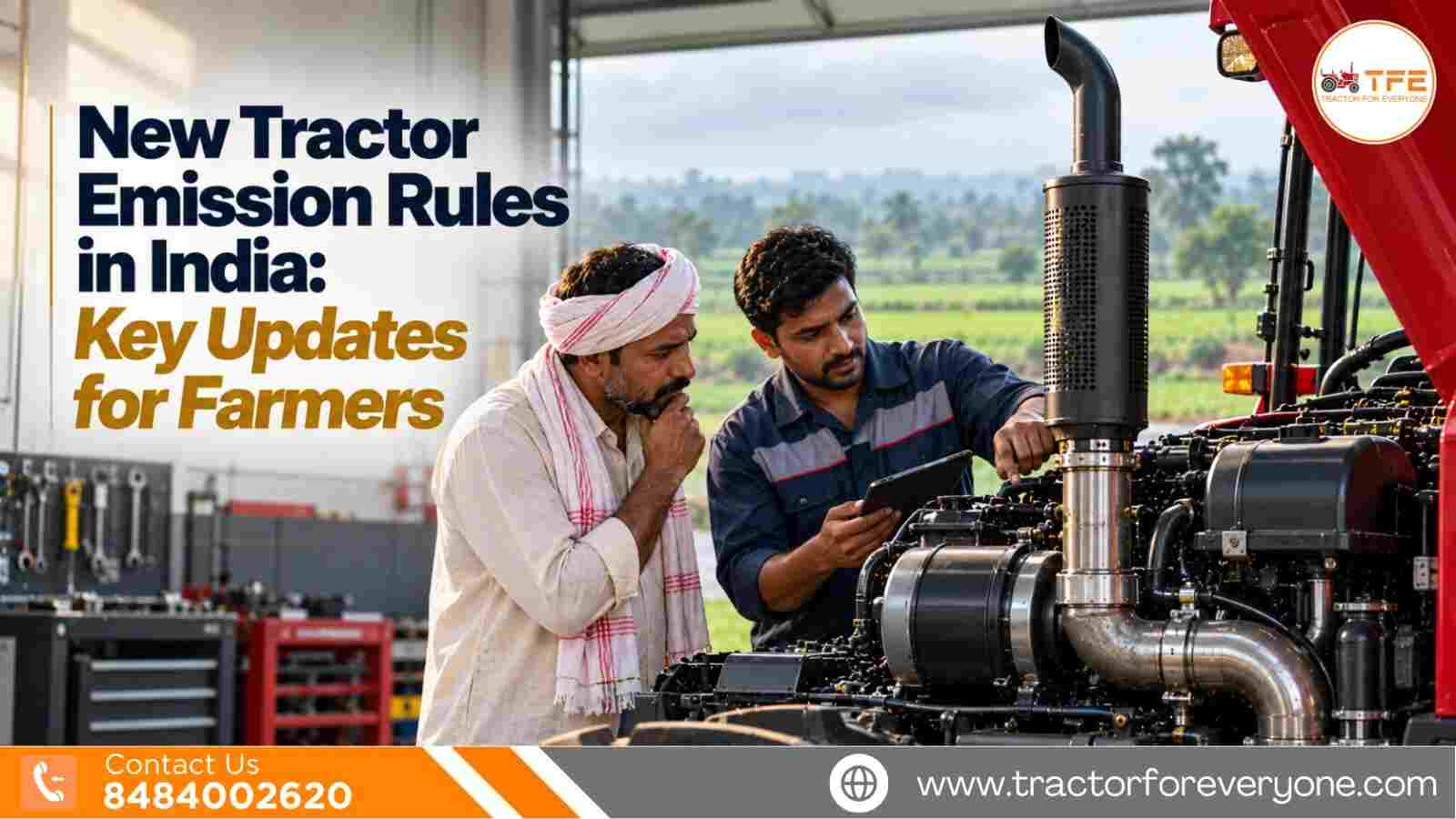
India's tractor emission rules are changing through a phased transition to stricter TREM Stage V standards. The Central Motor Vehicles (Eleventh Amendment) Rules, 2026, notified in July 2026, set different implementation dates according to engine power, making it important for farmers to check the applicable category before buying a new tractor.
TREM stands for Tractor Emission norms. These standards regulate pollutants produced by agricultural tractor engines and are intended to reduce harmful exhaust emissions through improved engine and emission-control technology. For farmers, the practical questions are which horsepower categories are affected, whether tractor prices may change, and how to compare new models with tractors already available in the market.
The new tractor emission framework introduces a phased transition to TREM Stage V for specified engine-power categories. The rules amend Rule 115A of the Central Motor Vehicles Rules, 1989, which covers emissions from agricultural tractors, power tillers, combine harvesters and certain other machinery.
The Ministry of Road Transport and Highways (MoRTH) issued the Central Motor Vehicles (Eleventh Amendment) Rules, 2026, in the Official Gazette in July 2026. The notified framework includes TREM Stage V standards and an intermediate TREM Stage IIIAA category for part of the tractor market. The implementation date depends on engine power—not simply the tractor's model year or advertised horsepower.
The key points are:
TREM IV: Already applies to the specified 37–56 kW agricultural tractor category from January 2023.
TREM V: Applies to specified lower- and higher-power categories from 1 October 2026.
TREM IIIAA: An intermediate stage applies to the 19–37 kW category from 1 April 2028.
Further TREM V transition: The notified schedule sets 1 April 2032 for the 19–56 kW categories under the TREM V table.
These dates are based on the notified 2026 rules, not merely the earlier draft proposal. Farmers and dealers should consult the Gazette and confirm the certification status of a specific tractor model before relying on a general timeline.
TREM IV and TREM V are successive emission-standard stages for agricultural machinery engines. TREM V introduces stricter requirements for specified engine categories, including tighter limits for particulate matter and particle number in applicable power bands.
The standards assess emissions such as:
Carbon monoxide (CO): A harmful gas produced by incomplete combustion.
Hydrocarbons (HC): Unburned or partly burned fuel-related compounds.
Nitrogen oxides (NOx): Pollutants formed during high-temperature combustion.
Particulate matter (PM): Small solid or liquid particles in exhaust.
Particle number (PN): A measure of the number of emitted particles, where applicable.
The regulations specify limits in grams per kilowatt-hour for relevant pollutants and set out the testing cycles that manufacturers must use. The exact limits vary by engine-power category and test procedure.
| Topic | TREM IV | TREM V |
|---|---|---|
| Regulatory stage | Earlier standard for applicable categories | Stricter later standard for applicable categories |
| Main objective | Control engine exhaust emissions | Further reduce specified exhaust pollutants |
| Implementation | Already applicable to specified tractor categories | Phased according to the notified 2026 schedule |
| Manufacturer implications | Engines must meet the applicable TREM IV limits | Applicable engines must meet the relevant TREM V limits |
| Buyer consideration | Check the tractor's certified emission category | Check whether the specific model meets the stage required on the purchase date |
A TREM V tractor is not automatically more powerful than a TREM IV tractor. Emission stage describes regulatory compliance, not engine horsepower, torque, fuel consumption or pulling capacity.
The 2026 rules set different dates for engine-power bands, so there is no single TREM V start date for every tractor in India. The following table summarises the notified schedule using approximate horsepower equivalents for easier reading.
| Engine power | Approximate HP equivalent | Notified stage and date |
|---|---|---|
| Below 8 kW | Below 10.7 HP | TREM V from 1 October 2026 |
| 8 kW to below 19 kW | About 10.7 to below 25.5 HP | TREM V from 1 October 2026 |
| 19 kW to below 37 kW | About 25.5 to below 49.6 HP | TREM IIIAA from 1 April 2028; TREM V from 1 April 2032 |
| 37 kW to below 56 kW | About 49.6 to below 75.1 HP | TREM IV from 1 January 2023; TREM V from 1 April 2032 |
| 56 kW to below 130 kW | About 75.1 to below 174.3 HP | TREM V from 1 October 2026 |
The notified rules also include categories above 130 kW; those categories are generally outside the typical farm-tractor segment purchased by most small and medium-sized farmers.
Important: Horsepower values are approximate conversions from kilowatts. Regulatory classification is based on the applicable engine power in kilowatts, so do not classify a model solely by rounding its marketed HP figure. Check the engine's approved rating and certification documents.
TREM Stage IIIAA is an intermediate emission stage included in the notified framework for the 19–37 kW engine category. It sets requirements for that category before the scheduled transition to TREM V in 2032.
For farmers, this matters because many tractors used for general cultivation, sowing, spraying and transport fall within or near this power range. However, the precise category depends on the engine's certified power rating, and not every tractor in a loosely defined “25–50 HP” marketing segment will necessarily be classified identically.
The intermediate stage creates a phased regulatory path rather than applying the same deadline to all tractor sizes. It also means that farmers comparing tractors should ask dealers which emission stage applies to the particular engine model and when the relevant manufacturing or sale requirements take effect.
Do not interpret TREM IIIAA as an optional upgrade chosen by a farmer. It is part of the regulatory framework for the specified category and implementation date.
Stricter emission standards can require manufacturers to revise engine calibration, combustion systems and exhaust after-treatment technology. The specific equipment depends on the engine design, power category and the compliance strategy approved for the model.
Possible technology changes in modern diesel engines include:
Improved combustion management: Engine design and calibration can help control pollutant formation.
Electronic engine controls and sensors: Depending on the model, these can monitor operating conditions and help regulate engine performance.
Exhaust after-treatment: Technologies may include diesel oxidation catalysts, particulate filters or selective catalytic reduction systems where required by the applicable design and standard.
More detailed testing and compliance checks: Manufacturers must demonstrate that covered engines meet the applicable limits under prescribed test procedures.
Not every TREM V tractor will necessarily use the same hardware. Farmers should not assume that all models need a diesel particulate filter, AdBlue or selective catalytic reduction; these details must be verified against the manufacturer's specifications for the exact tractor.
The wider technology trend is a shift toward cleaner engine operation and more sophisticated emission compliance. For buyers, the useful comparison is not the presence of a particular component by itself, but the tractor's certified compliance, operating requirements, service support and total ownership cost.
Stricter emission compliance may increase manufacturing costs for some models, but the price effect will vary by manufacturer, engine category, equipment package and market conditions. There is no reliable single increase that can be applied to every tractor after the rule change.
Potential cost factors include revised engine components, emission-control systems, electronic controls, testing and certification, and changes to manufacturing processes. These costs may influence the final ex-showroom price, but the actual effect depends on each manufacturer's strategy and the competitive market.
Farmers should compare the on-road price rather than assume a fixed percentage increase. Request written quotations for comparable models and check whether the quoted tractor's emission certification meets the requirements applicable on the purchase date.
A higher purchase price does not automatically mean lower fuel consumption or a faster payback period. Fuel economy depends on engine design, load, implement selection, soil conditions, maintenance and operating technique. Compare verified specifications and, where possible, practical field-performance information before deciding.
Farmers should verify the tractor's approved emission stage, engine power category, price and service requirements before paying a booking amount. A dealer's verbal description or broad horsepower label is not a substitute for model-specific documentation.
Use this checklist:
Confirm engine power: Ask for the rated engine power in kW and HP as shown in the official specifications.
Verify the emission stage: Check whether the model is certified to the stage applicable to its category and date.
Ask for documentation: Request the relevant model details and certification information from the authorised dealer.
Compare total cost: Review the ex-showroom and on-road price, financing charges, insurance and routine service expenses.
Check service support: Ask about spare parts, technician availability and maintenance procedures for any emission-control equipment fitted.
Evaluate actual farm needs: Match horsepower, PTO output, hydraulics, transmission and implement compatibility to your land and crops.
Get the offer in writing: Confirm model variant, manufacturing details, included accessories, delivery date and warranty terms.
For a used tractor, check the vehicle's registration, maintenance history, engine condition and relevant documents. Do not assume that the new-manufacture emission schedule automatically makes every older tractor illegal to own or operate. Check applicable vehicle rules and local requirements for the specific case.
The introduction of a new emission stage does not, by itself, mean that every previously purchased tractor becomes illegal overnight. The 2026 rules set requirements and implementation dates for the covered machinery categories; owners should verify the specific legal provisions applicable to their tractor and use.
Farmers who already own a tractor should keep its registration and other required documents current, maintain the engine according to the manufacturer's instructions and follow applicable transport and road-use rules. If buying a new tractor, confirm that the particular model meets the standards applicable to its category and date.
Do not rely on social media claims that all older tractors must be replaced by a single deadline unless those claims are supported by an applicable official notification. The notified implementation schedule is category-specific.
Farmers can prepare by checking the emission category of tractors they plan to purchase, comparing written quotations and understanding any model-specific maintenance requirements. There is no need to replace a working tractor solely because a newer emission stage has been announced without first checking the rules that apply to the existing vehicle.
Practical steps include:
Ask dealers for the emission stage and rated power of shortlisted models.
Compare tractor models based on field work, fuel use, service availability and ownership cost.
Confirm whether a model is currently available and compliant for the intended purchase date.
Keep invoices, warranty information and maintenance records.
Follow official MoRTH notifications and information from authorised manufacturers rather than relying on unverified online claims.
Farmers should also consider whether a tractor's capability matches their actual operations. Choosing the right engine power and compatible implements can have a significant effect on operating costs, regardless of the emission stage.
The phased TREM framework is a regulatory and technology change for India's agricultural machinery sector. It sets a path toward stricter emission limits while applying different dates to different engine-power categories.
For farmers, the most important step is to check the exact power category and certified emission stage of a tractor before buying. The impact on price, maintenance and operation will depend on the specific model and technology used, so avoid generalising from one manufacturer's product to the entire market.
Tractor For Everyone provides tractor information and comparison resources to help farmers research models and specifications. Use those resources alongside official government notifications and manufacturer documentation when making a purchase decision.
Popular Blogs View All

Popular Video View All
Best Used Car, Services, Auto Parts, Rent Car Available for Buy and Sell Near By Go Ahead
