
 Sell Your Tractor

Best Used Car, Services, Auto Parts, Rent Car Available for Buy and Sell Near By Go Ahead
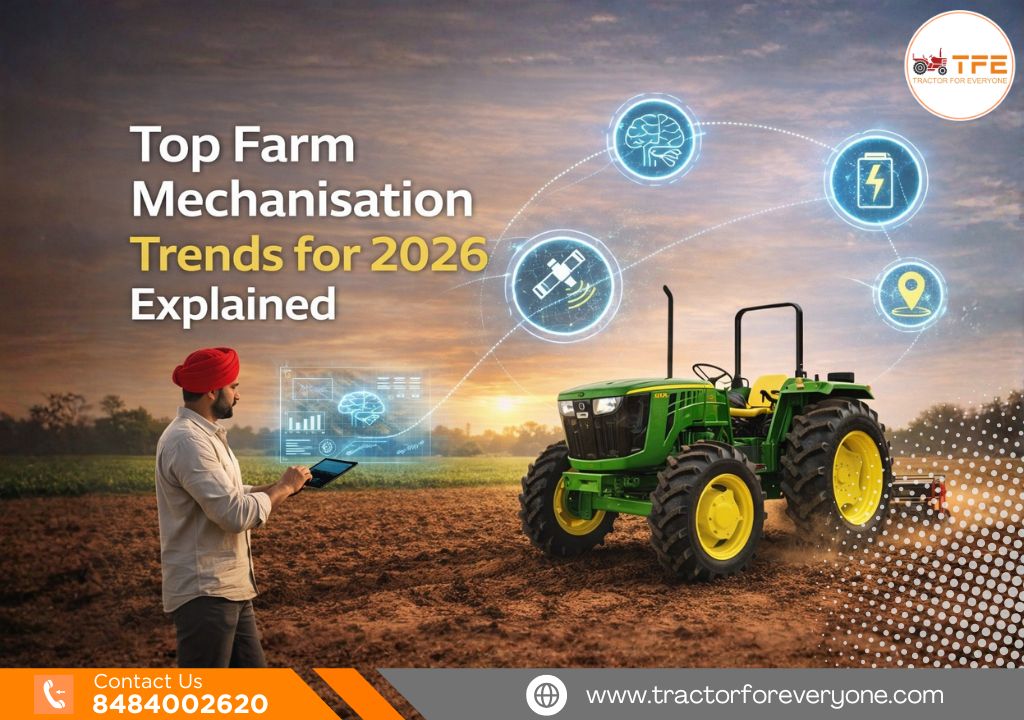
Tractor technology trends in 2026 represent the single biggest shift in agricultural machinery in decades. The question is no longer how powerful a tractor is — it is how smart it can be. Across India and globally, farm mechanisation trends 2026 are being shaped by artificial intelligence, satellite connectivity, emission regulations, and flexible ownership models.
This article covers every major development in agricultural machinery trends 2026 — from AI decision-making and autonomous tractors to electric powertrains, precision farming equipment, telematics, and the fast-growing Tractor-as-a-Service (TaaS) model. Whether you farm 5 acres or 500, understanding these shifts will help you make better decisions for the season ahead.
Key Takeaways at a Glance
AI tractors in 2026 are machines equipped with onboard computing systems, sensors, and cloud connectivity that analyse field data and provide instant recommendations to the operator. Unlike conventional tractors, they do not just perform tasks — they actively advise on when, where, and how to act.
The AI systems built into modern tractor dashboards monitor soil moisture levels, track fuel efficiency in real time, log engine load patterns, and send automatic service alerts. Through connected farm technology and IoT platforms, this data is synced to the cloud where machine learning models refine advice across seasons.
AI Features Now Standard in Smart Tractors
This is the core of smart farming technology 2026 and marks a decisive move toward the future of farm mechanisation where data, not instinct alone, guides every decision.
Autonomous tractors and automation are among the most discussed topics in agricultural machinery trends 2026. The honest answer is that fully driverless farms remain a work-in-progress — but semi-autonomous tractors are already operational across multiple farming regions and delivering measurable results.
Brands including John Deere and Monarch Tractor have deployed systems that combine GPS auto-steering, boundary sensors, obstacle detection, and remote monitoring. These are not concept machines. They are working in fields today, completing tasks like ploughing, spraying, and row planting with reduced human supervision.
What Semi-Autonomous Tractors Deliver Right Now
This automation connects directly to precision farming equipment trends, where tractors adjust seed rate, fertilizer flow, and spray volume in real time based on field zone data. That integration is what separates smart farm mechanisation from simple motorisation.
The electric tractor market growth in 2026 is not just an environmental story — it is a financial one. The introduction of TREM V emission norms for tractors in India (effective April 2026 for 50 HP and above) has increased the manufacturing and purchase cost of diesel tractors, making the total cost of ownership comparison far more competitive for electric alternatives.
Electric tractors now operate across orchard farming, dairy operations, greenhouse management, and light utility tasks. They run quietly, require fewer moving parts, and eliminate fuel costs that have historically been one of the largest ongoing expenses for farm operators.
|
Feature |
Diesel Tractor |
Electric Tractor |
|
Fuel / Energy Cost |
High — subject to price volatility |
Low — solar or grid charging |
|
Maintenance |
Regular engine servicing required |
Fewer moving parts, lower upkeep |
|
Emissions |
Higher CO₂ and particulate output |
Zero tailpipe emissions |
|
Noise Level |
Loud — unsuitable near livestock |
Quiet — ideal for dairy and greenhouses |
|
TREM V Impact |
Increased purchase price (50 HP+) |
Not affected — no emission regulation |
|
Operating Cost Saving |
Baseline |
30–40% lower than diesel equivalent |
|
Rural solar charging infrastructure and government energy support programs are accelerating electric tractor market growth further, making clean mechanisation increasingly accessible beyond large commercial farms.
Precision farming equipment trends in 2026 centre on one idea: treat every part of your field differently, based on what that part actually needs. Variable Rate Technology (VRT) farming is the system that makes this possible at scale.
With GPS mapping and soil sensors, VRT-equipped tractors automatically adjust the rate at which they apply seeds, fertilizer, or pesticide as they move across a field. A section with high soil moisture receives less irrigation. A section with poor nutrient density receives a higher fertilizer dose. All of this happens automatically, without the operator manually adjusting anything.
Connected farm technology and IoT link these data streams directly to the tractor display, making the tractor a true field data hub rather than simply a pulling machine. This integration is what defines the digital agriculture transformation of 2026.
Telematics is now a standard feature across premium tractor models and is quickly becoming common in mid-range segments. Under tractor technology trends 2026, fleet monitoring allows farm owners and contractors to track every machine's idle time, fuel consumption, engine hours, and GPS route history from a single dashboard.
Predictive maintenance in tractors is one of the most practically valuable outputs of telematics data. By analysing usage patterns, the system identifies components approaching failure and alerts the operator before a breakdown occurs. During peak harvest season, avoiding even a single unplanned downtime event can mean the difference between a successful and a compromised harvest.
Key Telematics Capabilities in 2026
The Tractor-as-a-Service (TaaS) model is one of the most important access-related developments in farm mechanisation trends 2026. High-technology tractors — particularly those with AI systems, precision equipment, and electric powertrains — carry purchase prices that remain out of reach for small and medium farm operators.
TaaS solves this through pay-per-hour rental apps, custom hiring centres, and cooperative fleet programs. Farmers access the exact machine they need, for the exact duration required, without taking on full ownership costs or maintenance responsibilities.
|
|
Factor |
Full Ownership |
TaaS / Rental Model |
|
Upfront Cost |
High — full purchase price |
Low — pay per hour of use |
|
Maintenance |
Owner responsibility |
Provider responsibility |
|
Technology Access |
Fixed at purchase spec |
Access to latest models each season |
|
Suitable For |
Large farms with year-round use |
Small/medium farms or seasonal needs |
|
Resale Risk |
Owner absorbs depreciation |
No resale risk for the farmer |
All of the trends covered above — AI, autonomy, electrification, precision farming, telematics, and TaaS — are individual expressions of a single, larger shift: the digital agriculture transformation of 2026.
Connected farm technology and IoT are the infrastructure layer beneath everything. Tractors, soil sensors, weather stations, and irrigation systems now share data on a common platform. Farm managers can view a complete operational picture — field by field, machine by machine — from a mobile device.
This transformation is redefining what a tractor is. It is no longer a machine that a farmer operates. It is increasingly a machine that helps a farmer decide.
The farm mechanisation trends of 2026 are clear: growth is no longer about bigger machines or more land. It is about better output per acre, lower cost per input, and smarter decisions per season.
Tractors in 2026 are AI-powered, emission-conscious, data-connected command centres. Whether you are a smallholder exploring TaaS options, a progressive farmer adopting precision VRT systems, or a large operator building a connected fleet — the technology now exists to make every acre more productive and every input more precise.
Key highlights shaping 2026 farming:
The most significant shift is the integration of AI and connected IoT systems directly into tractor dashboards, enabling real-time crop advice, predictive maintenance alerts, and automated precision farming — moving tractors from tools to decision partners.
Electric tractors are well-suited to orchards, dairy farms, greenhouses, and utility tasks where noise reduction and lower operating costs are valuable. For heavy draft and high-HP field work, diesel remains more common, though the gap is narrowing rapidly.
TREM V (Tractor and Road Equipment) emission norms in India, effective April 2026 for tractors above 50 HP, require manufacturers to meet stricter pollution standards. This increases engine and component costs, pushing up diesel tractor purchase prices and accelerating interest in electric alternatives.
VRT uses GPS mapping and soil sensor data to automatically adjust seed, fertilizer, and pesticide application rates as the tractor moves through different field zones. Farms using VRT consistently report 15–20% productivity improvements and measurable reductions in input waste.
TaaS is a rental-based access model where farmers pay for tractor use by the hour through digital apps or local hiring centres. It eliminates upfront ownership costs and maintenance responsibilities, making advanced smart tractors accessible to small and medium-scale farmers.
The right tractor depends on your farm size, crop type, HP requirement, and whether you need smart technology features. Use the Choose Right Tractor and Know Your Tractor tools on tractorforeveryone.com for personalised guidance. You can also compare models and check current pricing on the New Tractors and Compare Tractors pages.
Flexible EMI plans, subsidy guidance, and financing options are available on the Finance and Loans pages at tractorforeveryone.com. Insurance coverage for breakdown and damage is detailed on the Insurance page. For personal support, contact the team at (+91) 8484002620 or info @ tractorforeveryone.com.
Popular Blogs View All

Popular Video View All
Best Used Car, Services, Auto Parts, Rent Car Available for Buy and Sell Near By Go Ahead
