
 Sell Your Tractor

Best Used Car, Services, Auto Parts, Rent Car Available for Buy and Sell Near By Go Ahead
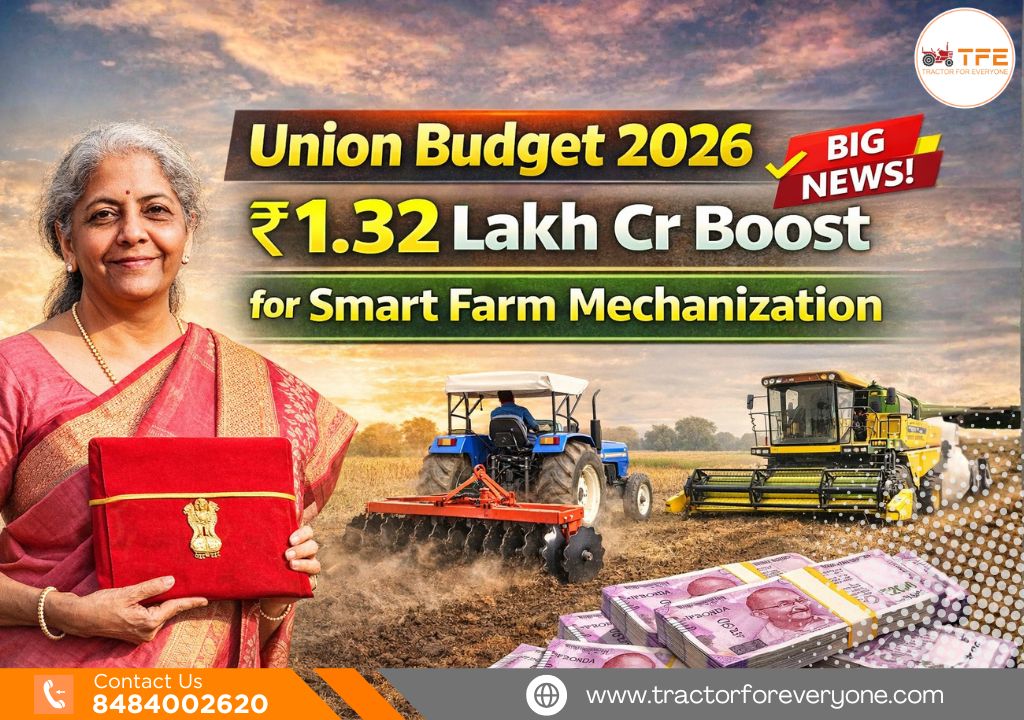
India's Union Budget 2026 allocated ₹1,32,561 crore to the Department of Agriculture for FY 2026–27, marking the largest farm mechanization budget in Indian history. The budget directly supports tractor demand, smart farming platforms, and precision agriculture through targeted subsidies, AI-powered advisory systems, and state-level matching schemes.
The Union Budget 2026 agriculture allocation is ₹1,32,561 crore for FY 2026–27, announced by Finance Minister Nirmala Sitharaman on February 1, 2026. This represents the government's largest-ever investment in farm mechanization, precision agriculture, and rural infrastructure under the Viksit Bharat mission.
Finance Minister Nirmala Sitharaman presented the Union Budget 2026 on February 1, 2026. The ₹1,32,561 crore agriculture department allocation marks a consistent upward trajectory compared to previous fiscal years. Officials have framed the strategy around 'outcome-linked investments' as part of the Viksit Bharat 2047 roadmap.
For the tractor and farm equipment industry, this allocation signals rural economic stability. Higher government spending boosts farm incomes, which in turn increases farmer confidence in capital purchases such as tractors and precision implements. Industry analysts predict elevated positive sentiment ahead of the Kharif 2026 season.
Bharat VISTAAR is India's national AI-powered agricultural advisory platform, launched under Union Budget 2026 with an initial outlay of ₹150 crore. It integrates with AgriStack — India's unified digital agriculture infrastructure — to deliver soil analysis, crop recommendations, and localized weather data in regional languages.
Key Entity: Bharat VISTAAR (Vibrant, Integrated, and Sustainable Technology for Agriculture and Rural Growth)
Parent System: AgriStack — India's unified digital agriculture data layer
Budget Outlay: ₹150 crore for initial FY 2026–27 rollout
Supported Languages: All 22 scheduled Indian languages
The platform changes farmer purchasing behavior. Data-backed recommendations mean farmers select implements like Laser Land Levellers, Super Seeders, or rotavators based on soil and crop intelligence — not guesswork. OEMs (Original Equipment Manufacturers) are expected to integrate telematics into tractors to align with advisory outputs from Bharat VISTAAR.
The tractor industry impact of Bharat VISTAAR is expected to be strongest in mid-segment (41–55 HP) and premium-segment (above 55 HP) categories, where precision linkage with smart implements adds measurable yield benefits.
Compact tractor demand in India is projected to grow by 12–15% in 2026, driven by Budget 2026 crop diversification programs targeting cashew, cocoa, coconut, and sandalwood cultivation in southern and western states. These crops require narrow-track and compact tractors (below 40 HP), creating a distinct sub-market that traditional mid-range tractors cannot serve.
Budget 2026 introduced dedicated development programs for four high-value horticulture crops. The government also announced orchard rejuvenation schemes, which will increase demand for mulchers, shredders, and pruning attachments — equipment segments where compact tractors dominate.
India is already the world's largest tractor market by volume (approximately 9–10 lakh units sold annually). Budget 2026 accelerates a structural shift from bulk commodity farming toward specialised, high-value horticulture — creating a new demand layer for compact machinery.
The Sub-Mission on Agricultural Mechanization (SMAM) 2026 has been restructured to prioritise Custom Hiring Centers (CHCs) and Farmer Producer Organizations (FPOs) over individual tractor ownership. This policy shift enables small and marginal farmers — who represent 86% of India's farming households — to access premium equipment without full capital outlay.
SMAM 2026 reforms introduce bundled mechanization solutions — a farmer accesses a tractor, implements, and crop advisory as a package through a CHC, rather than purchasing each independently. This model expands reach to economically marginal regions in Bihar, Uttar Pradesh, Odisha, and Madhya Pradesh.
Direct Benefit Transfer (DBT) mechanisms within SMAM 2026 improve subsidy transparency. Funds go directly to farmer bank accounts, reducing leakage and increasing effective uptake of tractor purchase programs.
|
Component |
Old Model |
New Model (2026) |
|
Primary Beneficiary |
Individual farmer |
CHC / FPO |
|
Equipment Access |
Ownership via subsidy |
Shared hiring model |
|
Subsidy Delivery |
Manual/Dealer routed |
Direct Benefit Transfer (DBT) |
|
Implements Covered |
Tractor only |
Tractor + implement bundle |
|
Target States |
All states equally |
Priority: low-mechanization states |
Gujarat has announced a record ₹800 crore tractor subsidy allocation under its 2026 agriculture scheme, with per-unit caps reaching ₹1 lakh — the highest state-level tractor support in India. This subsidy is specifically designed to offset the price increase expected from TREM V emission norm compliance, which adds an estimated ₹40,000–₹80,000 to tractor manufacturing costs.
Beyond Gujarat, multiple states have aligned their subsidy calendars with SMAM 2026. States with low mechanization index (below 1.5 kW/ha) — including Bihar, Jharkhand, and Assam — are expected to see the largest percentage uplift in tractor adoption due to combined central and state support.
|
State |
Allocation |
Key Scheme Feature |
|
Gujarat |
₹800 Crore |
Up to ₹1 lakh per unit; TREM V offset support |
|
Bihar |
Under SMAM CHC |
FPO-linked group purchase subsidy |
|
Maharashtra |
State + SMAM |
Compact tractor focus for horticulture belt |
|
Tamil Nadu |
State scheme |
Narrow-track subsidy for plantation crops |
|
Odisha |
DBT-enabled |
Low-mechanization priority; zero-till equipment |
The Union Budget 2026 allocated ₹1.70 lakh crore for fertiliser subsidies — higher than the agriculture department's own allocation — directly stabilizing farmer input costs and protecting the farm income margins that drive tractor purchase decisions. Stable fertiliser prices mean farmers retain more discretionary income to invest in tractors and implements.
The fertiliser subsidy acts as an indirect demand driver for the tractor market. When urea and DAP prices remain stable, farmers avoid cost-cutting on equipment maintenance and new purchases. Industry analysts estimate that every 10% reduction in fertiliser cost burden corresponds to a 3–5% uplift in discretionary farm capex spending.
The Indian Council of Agricultural Research (ICAR) received ₹9,967 crore in Budget 2026, with a mandate focused on climate-resilient crop varieties and soil conservation practices. This funding will drive demand for Zero Till Seed Drills, Happy Seeders, and residue management implements — equipment categories that are growing faster than conventional tillage machinery.
ICAR's 2026 research agenda prioritises three interconnected areas: (1) development of drought-tolerant and short-duration crop varieties, (2) mechanized conservation agriculture protocols, and (3) real-time soil health monitoring tools. Each area creates demand for a distinct category of smart farming equipment.
The following table summarises all major budget components relevant to farm mechanization and the Indian tractor market:
|
Budget Component |
Entity / Scheme Name |
Allocation (FY 2026–27) |
Tractor / Mechanization Impact |
|
Agriculture Department |
Dept. of Agriculture, GoI |
₹1,32,561 Crore |
Rural income boost; capex confidence |
|
Fertiliser Subsidy |
NBS & Urea Subsidy Scheme |
₹1.70 Lakh Crore |
Protects farm margins; indirect tractor demand driver |
|
AI Farming Platform |
Bharat VISTAAR |
₹150 Crore |
Drives smart tractor and telematics adoption |
|
Farm Mechanization |
SMAM 2026 (Restructured) |
Part of Agri corpus |
CHC/FPO model; shared access to premium equipment |
|
State Tractor Subsidy |
Gujarat State Scheme |
₹800 Crore |
Up to ₹1 lakh/unit; cushions TREM V price rise |
|
Agri Research |
ICAR FY 2026–27 |
₹9,967 Crore |
Conservation equipment demand; zero-till drills |
|
Crop Diversification |
Horticulture Mission 2026 |
Part of Agri corpus |
12–15% compact tractor demand growth |
|
Digital Agriculture |
AgriStack Integration |
Bundled in VISTAAR |
Data-linked implement selection; OEM integration |
India allocated ₹1,32,561 crore (approximately ₹1.32 lakh crore) to the Department of Agriculture and Farmers Welfare for FY 2026–27 in the Union Budget 2026, presented by Finance Minister Nirmala Sitharaman on February 1, 2026. This is the highest-ever annual allocation for Indian agriculture, representing a strategic shift from broad subsidies to targeted, outcome-based investment in mechanization, precision farming, and digital agriculture infrastructure.
Bharat VISTAAR (Vibrant, Integrated, and Sustainable Technology for Agriculture and Rural Growth) is India's government-launched AI-powered farming advisory platform, funded at ₹150 crore in Budget 2026. It integrates with AgriStack to provide farmers with personalised recommendations on crop choice, soil preparation, irrigation scheduling, and implement selection — all in regional languages. For farmers, this means choosing the right tractor attachment or seed drill based on data rather than guesswork, which directly improves yield efficiency and reduces input waste.
Yes, TREM V (Tractor and Non-Road Mobile Machinery Emission Standard Stage V) compliance is expected to add ₹40,000–₹80,000 to the ex-factory price of tractors in India. However, state-level subsidies — most notably Gujarat's ₹800 crore tractor scheme offering up to ₹1 lakh per unit — are specifically designed to offset this cost increase for farmers. Buyers in other states may access SMAM 2026 support through Custom Hiring Centers or FPO group purchase schemes that provide equipment at subsidised hire rates.
Based on Budget 2026 allocations, the states projected for highest tractor sales growth in 2026 are:
(1) Gujarat — due to ₹800 crore state subsidy
(2) Maharashtra and Karnataka — due to compact tractor demand from horticulture crop programs
(3) Bihar, Jharkhand, and Assam — due to SMAM 2026 CHC expansion targeting low-mechanization districts
(4) Tamil Nadu and Kerala — due to narrow-track compact tractor demand from coconut and cashew plantations. National market analysts forecast 12–15% growth in the compact tractor segment (below 40 HP) across southern and western states.
The ₹1.70 lakh crore fertiliser subsidy in Budget 2026 — which exceeds even the agriculture department's own allocation — acts as an indirect demand driver for tractor sales. By keeping urea and DAP prices stable for farmers, the subsidy protects net farm income. Higher retained income means farmers have more discretionary capital available for machinery investment. Industry analysis suggests that every 10% reduction in fertiliser cost burden corresponds to a 3–5% increase in farm capex spending on tractors and implements.
Popular Blogs View All

Popular Video View All
Best Used Car, Services, Auto Parts, Rent Car Available for Buy and Sell Near By Go Ahead
